
Last week was a busy one at DEFRA for Biodiversity Net Gain. Hot on the heels of what can only be described as a very busy day in Marsham Street, the government has published its responses to two significant consultations: one on changing BNG requirements for minor, medium, and brownfield sites, and one on BNG for Nationally Significant Infrastructure Projects (NSIPs). There's also a brand new consultation quietly slipped out - more on that below.
If you're a developer, planner, or anyone whose Monday morning involves the phrase "biodiversity metric," this one's for you.
Key Highlights
- DEFRA has confirmed a new area-based exemption for sites smaller than 0.2 hectares
- The exemption for self-build and custom build development is being removed from 31st July 2026
- New exemptions introduced for biodiversity-led development, temporary planning permissions, and development enhancing parks and public gardens
- The biodiversity gain hierarchy for minor development is being amended, giving developers more flexibility on off-site gains
- A brand new consultation on brownfield residential BNG exemptions is open until 10th June 2026
- DEFRA plans to move to a fully digital biodiversity metric
- The spatial risk multiplier methodology is being updated to use LNRS areas only
The Small Sites Shake-Up
The biggest headline for most developers will be the changes to how BNG applies to smaller sites. DEFRA has confirmed a new area-based exemption for sites smaller than 0.2 hectares - a pragmatic move that acknowledges the disproportionate burden the metric can place on minor development. If your site is genuinely tiny, you may now be off the hook entirely.
But it's not all good news for small-scale developers. The exemption for small-scale self-build and custom build development is being removed, which will catch some off guard. If you've been relying on that carve-out, now is the time to factor BNG back into your appraisals.
On the more positive side, new exemptions are being introduced for:
- Development whose primary objective is to conserve or enhance biodiversity
- Temporary planning permissions covering a maximum of five years
- Development that enhances parks, playing fields, and public gardens
These feel like sensible additions; the idea that a community garden project should need to demonstrate 10% biodiversity uplift was always a little absurd.
Changes to the Metric and Methodology
Beyond the exemptions, DEFRA has confirmed a raft of methodological changes that will matter to anyone working with the biodiversity metric day-to-day:
Digital metric
Plans are afoot to move to a fully digital version of the metric. This is long overdue and will be welcomed by anyone who has spent quality time wrestling with the current spreadsheet.
Biodiversity gain hierarchy (minor development only)
For minor development specifically, DEFRA intends to amend the hierarchy so that off-site biodiversity gains sit on the same preference level as on-site enhancement and habitat creation. This is a notable shift; it effectively reduces the pressure to deliver gains on-site for smaller schemes, giving developers more flexibility about where and how they deliver their BNG obligations.
Spatial risk multiplier
The methodology for assessing spatial risk will be updated to use Local Nature Recovery Strategy (LNRS) areas only, rather than the current combination of local planning authority and National Character Area boundaries. This should make assessments more consistent and ecologically meaningful.
Open Mosaic Habitat (OMH)
DEFRA has also signalled a review of the rules around OMH, with the intention of making metric and guidance changes to allow proxy habitats as a suitable alternative where no OMH units are available. Anyone who has tried to calculate OMH units on a complex brownfield site will appreciate the intent here, even if the devil will be in the detail.
When Is All This Happening?
DEFRA has set out a staggered implementation timetable, with the following changes targeted for 31st July 2026:
- The new 0.2 hectare area-based exemption
- Removal of the self and custom build exemption
- Exemption of temporary planning permissions (maximum five years)
- Amendments to the biodiversity gain hierarchy for minor development
The exemptions for biodiversity-led development and targeted development enhancing parks, playing fields, and public gardens will follow later in the year.
With July 2026 not far off, now is the time to understand which of your pipeline sites will be affected - and to make sure your BNG assessments are being done early enough to inform decisions rather than delay them.
A Brand New Consultation: Brownfield Residential Development
Buried at the end of the update - but worth your attention - is a new consultation on whether to introduce a targeted exemption for certain types of brownfield residential development.
The detail on what "certain types" means is still to be worked through, but the direction of travel is clear: DEFRA recognises that applying the full weight of BNG requirements to brownfield residential sites - where baseline biodiversity is often low and remediation costs are already high - can act as a genuine barrier to development.
The consultation runs until 10th June 2026. If brownfield development is part of your business, this is one to respond to.
What This Means in Practice
Taken together, these changes represent a meaningful recalibration of BNG - a recognition that the policy, while vital, needs to work with the grain of development rather than against it. The reduction in burden for minor development and the brownfield consultation in particular signal that DEFRA is listening to the industry.
But let's be clear: BNG isn't going away, and the 10% uplift requirement for most development remains firmly in place. Getting your biodiversity assessment right, early, is still one of the most important things you can do to de-risk a site.
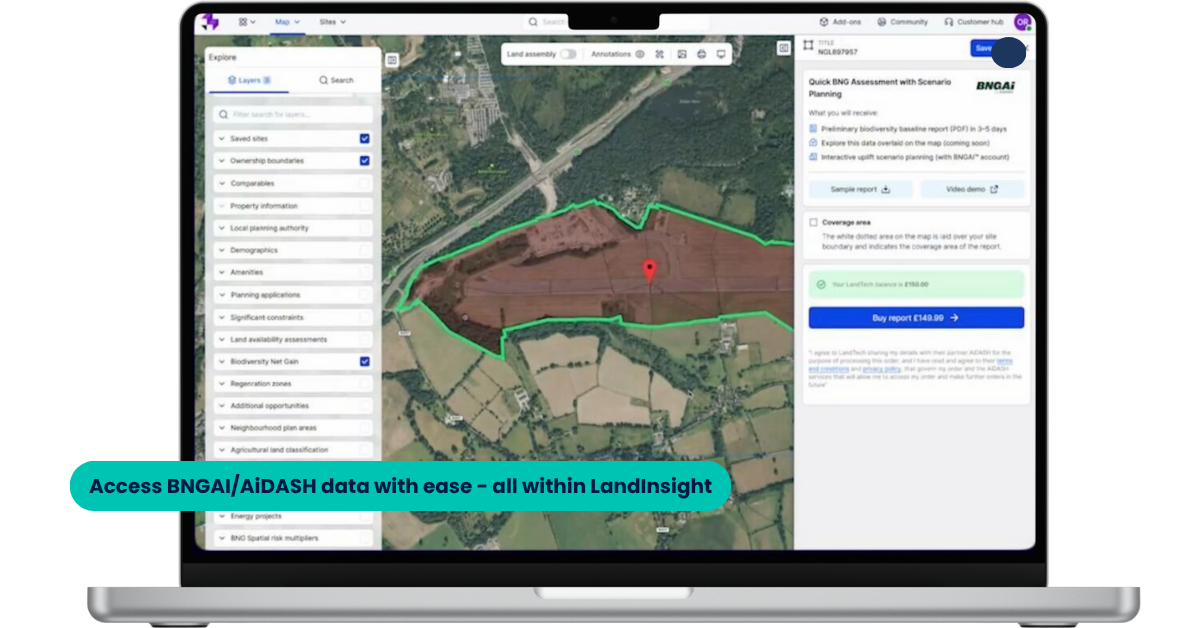
That's exactly why we partnered with BNGAI™ by AiDASH - to bring fast, reliable, Defra-compliant biodiversity assessments directly into LandInsight. Using high-resolution satellite imagery and AI, BNGAI™ can identify and classify habitats, calculate biodiversity units using the Defra Statutory Metric, and produce compliant reports in 3-5 days - without waiting for a seasonal site visit. You can model on-site, off-site, and credit-based uplift scenarios before you've even committed to a site.
As the rules shift and the metric evolves, having that intelligence at your fingertips - at the point of site assessment, not after heads of terms - is increasingly the difference between a smooth planning process and an expensive surprise.
For more information and to stay informed, visit the government’s website here - https://defraenvironment.blog.gov.uk/2026/04/20/biodiversity-net-gain-whats-changing-and-what-it-means-for-you/.
The new brownfield BNG consultation closes on 10th June 2026. The DEFRA consultation response documents can be found on GOV.UK.
As BNG requirements evolve, getting your biodiversity assessments right early has never mattered more. BNGAI™ by AiDASH is built into LandInsight, giving you fast, Defra-compliant habitat assessments before you've committed to a site.