

Type this question into Google and you'll find no shortage of platforms claiming to use AI for planning analysis. Fewer of them will tell you what "using AI" actually means in practice, which, it turns out, is doing quite a lot of heavy lifting in that sentence.
Some platforms have bolted a general-purpose chatbot onto their mapping tool and called it a feature. Others route your query out to an external AI model via an MCP connection and hope for the best. And a few have built the planning logic in-house, from the ground up, specifically for this job. These are not the same thing, even if the marketing copy sometimes reads that way.
Here's how to tell the difference, and where LandInsight's AI Assistant fits into the picture.
Key Highlights
- Not all "AI-powered" land sourcing tools work the same way; some route your query to an external AI model, others build planning logic in-house.
- The single most useful thing to check before trusting an AI output isn't speed, it's whether you can click through to the actual source behind a claim.
- Tools that rely on general-purpose AI (via MCP or embedded chatbots) typically require prompt engineering skill to get a reliable answer, and offer no way to verify the result.
- LandInsight's AI Assistant is anchored exclusively to LandTech's own institutional-grade data, with source-level citations built into every document.
- It's designed to accelerate the early stages of site sourcing, not replace the judgement your team brings to a final-stage transaction.
Not All AI-Powered Claims Mean the Same Thing
Broadly, platforms claiming AI-powered planning analysis fall into two camps.
The first hands the job off to an external AI model, either through an embedded chatbot or an MCP (Model Context Protocol) connection to something like Claude or ChatGPT. This can look impressive in a demo, but it comes with a catch: the AI reasoning happens outside the platform's own data. That means the accuracy of what you're told depends entirely on how well the underlying model was prompted, and how current its training data happens to be. Neither of those is something you, as the user, can easily check.
The second builds the planning logic natively, using the platform's own data and its own rules, rather than outsourcing the thinking to a general-purpose model. It's a slower, more deliberate way to build the feature, but it means the tool can actually be held accountable for what it tells you, because everything it says can be traced back to a specific, checkable source.
Worth saying plainly: the first approach isn't necessarily "worse AI." It's often the same excellent model you'd get from using ChatGPT directly. The issue is one of accountability, not intelligence. General-purpose AI wasn't built to cite official planning records, so unless a platform has done the extra work to force that behaviour, it won't do it by default.
What to Actually Check Before You Trust the Output
If you're evaluating land sourcing platforms and any of them mention AI, here's a short list of questions worth asking, ideally before you're three sites deep into a live pipeline and relying on the answer.
Can you click through to the source?
A trustworthy AI tool should let you verify a claim in seconds, not send you off to confirm it manually. If a platform tells you a site sits within a flood risk zone or a mineral safeguarding area, you should be able to see the actual record behind that statement, not just take its word for it.
Does it require you to learn how to prompt it well?
If getting a usable answer depends on phrasing your question a particular way, that's a sign the tool wasn't built with planning workflows specifically in mind. It also means the quality of what you get back is partly down to how good you are at prompting, which is an odd thing to be graded on when you're trying to assess a site.
Is the output a static wall of text, or does it stay editable?
Site briefs change. A tool that gives you one flat answer and then expects you to start again (or edit the output somewhere else entirely) adds friction exactly where you don't need it.
Does it live where your other site data already lives?
Every extra login, subscription, or browser tab you're managing is a small tax on your time. It adds up faster than people expect.
How LandInsight's AI Assistant Approaches This
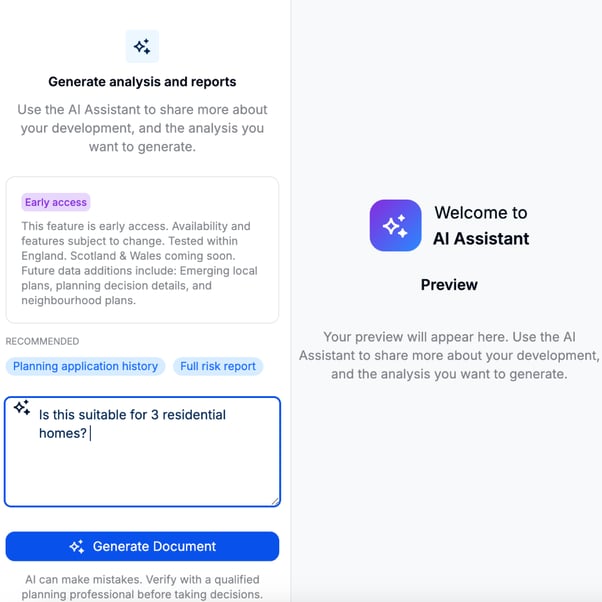
The AI Assistant, now live for LandInsight Unlimited subscribers, was built to answer each of those questions directly rather than leave you to work it out for yourself. For the fuller story on how and why we built it, see our AI Assistant launch article.
It's anchored exclusively to LandTech's own institutional-grade property data, kept current centrally, rather than reasoning from a general AI model's training data. Every document it generates carries source-level citations built directly in, so a claim about a flood risk designation or an NPPF tilted balance test links straight back to the actual record behind it.
It also stays editable. Add a requirement, challenge a constraint, or adjust your scheme, and the document updates with you, without exporting anywhere or starting again.
None of that makes it a substitute for professional judgement at the sharp end of a deal, and it isn't trying to be. It's built for the early stages of site sourcing, where the job is qualifying opportunities quickly and confidently, not signing off a multi-million pound transaction on an AI's say-so. Anyone telling you their AI tool can do the latter is, frankly, the one you should be double-checking.
The Short Version
If you're comparing land sourcing platforms on the strength of their AI claims, the question worth asking isn't "does it use AI?" Most things do now, in one form or another. It's "can I check its working?" Everything else follows from that answer.
Try the AI Assistant on your own saved sites inside LandInsight Unlimited, and judge it against that standard yourself.
Learn more by clicking the link below.
