

Property site sourcing is often described as a numbers game - find enough opportunities and eventually something will stack up. Experienced developers know that's not quite right.
Pipelines can look perfectly healthy on paper. Dozens of sites sourced through agents, portals, or landowner conversations. Yet months later, a local election reshuffles stakeholders, policy alignment turns out to be thinner than expected, or quiet community resistance does its slow work in the background. By that point, you've spent fees and absorbed internal resources you won't get back.
The problem is rarely access to opportunities. It's decision quality.
The most effective developers treat site sourcing as a structured screening discipline. The aim isn't to find more land - it's to filter faster, surface planning risk earlier, and only commit time and capital where the probability of consent actually justifies it. This guide sets out what that looks like in practice, and how high-performing teams use constraints, LPA behaviour, precedent, and comparables to build pipelines they can genuinely rely on.
LandInsight is built to systematise exactly this - consistent, defensible screening at scale.
Key Takeaways
- Property site sourcing is a decision-making process, not a lead generation exercise
- Planning risk can be assessed during sourcing, well before consultant engagement
- Strong pipelines come from consistent screening, not chasing volume
- The developers who pull ahead are usually the ones who've replaced instinct with evidence
What Property Site Sourcing Actually Means
In a development context, sourcing means identifying and prioritising land that's realistically capable of securing planning permission and generating viable value uplift. That's a very different discipline from buy-to-let sourcing, where yield rules dominate.
For developers, the core question is simpler and harder: can this site get consent, and under what conditions? Answer that early and your pipeline strengthens. Leave it late and risk compounds quietly until it doesn't.
Most sourcing strategies fall into three broad categories.
Agent-led and on-market sourcing is where professional land agents and platforms surface opportunities with headline planning context and indicative guidance. It's efficient, but competitive. Everyone sees broadly the same stock, so the edge rarely comes from access. It comes from how rigorously you interrogate what sits beneath the brochure description. Two sites can look similar in scale and location while their planning trajectories differ entirely once constraints and precedent are properly reviewed. If you're early in your journey, this is often where you'll first encounter a site. What matters next is how quickly you stress-test it.
Off-market and direct-to-landowner sourcing shifts the dynamic. Instead of competing in the open market, developers identify land proactively and approach owners directly - in theory reducing bidding pressure and creating stronger relationships. But off-market doesn't mean low risk. Because there's often less third-party scrutiny, the responsibility to assess planning probability early is actually greater. A positive landowner conversation isn't the same as policy alignment, and enthusiasm doesn't override constraints. Developers who succeed here combine persistence with early evidence-based assessment - particularly around planning history and ownership context.
Data-led and platform-enabled sourcing is where more developers are now operating, because manual research simply doesn't scale. Planning history, ownership data, and environmental constraints are rarely held in one place. That means screening becomes fragmented and inconsistent - and when every team member builds their own spreadsheets and reference points, decision-making becomes experience-led rather than system-led. That works up to a point, but it's hard to benchmark and harder to defend internally. Data-led sourcing replaces scattered research with structured inputs: every site assessed against the same criteria, comparison made meaningful, prioritisation made clearer.
Consistency, it turns out, is often the real competitive advantage.
Want to see data-led sourcing in action? Book a demo with LandTech.
Volume-Led Vs Quality-Led Sourcing
A larger pipeline can feel productive. In practice, volume often just hides weak filtering. Teams spend time reviewing marginal sites because they can't bear to miss out. Planning issues surface late because constraint screening wasn't robust enough at the start.
Quality-led sourcing applies structure from the beginning. High-performing teams apply consistent screening inputs, log decisions and rationale, and benchmark against local precedent rather than gut feel. The pipeline may be smaller - but it's stronger, and confidence in what's left grows because every opportunity has been put through the same lens.
What the Sourcing Process Should Look Like
A robust sourcing process won't replace detailed appraisal. But it should reliably prevent weak sites from progressing further than they deserve.
Most workflows fall into five stages.
Stage 1: Opportunity identification
Opportunities come from agents, landowner approaches, local plan updates, regeneration announcements, and infrastructure projects. The challenge isn't where to look — it's how quickly you apply structure once you find something. Clusters of recent approvals, emerging allocations, shifts in housing targets, or increased application activity can all signal changing planning dynamics. Developers who monitor these patterns proactively tend to be better positioned than those reacting to isolated listings. This is the thinking behind LandTech's Opportunities layer: surfacing areas where planning, policy, and market signals suggest genuine development potential before a site formally hits the market.
Stage 2: Constraint screening
This isn't full due diligence - it's disciplined triage. The aim is to surface obvious friction early, before you drift into planning cul-de-sacs that only become visible months later. A fast red-flag screen should look at flood risk, heritage designations, ecological sensitivities, access limitations, Green Belt policy, and brownfield status.
Stage 3: Planning risk assessment
At the sourcing stage, this is a probability judgement, not a full appraisal. The question is: given policy alignment, site constraints, and the track record of the local authority, how likely is consent? That requires structured evidence - whether local housing targets are being met, whether similar schemes have been approved, whether there are recurring refusal themes. Confidence in reading planning policy as it's applied locally, not just as it's written, is essential at this stage. LandInsight's Property Information layer supports exactly this kind of early review.
Stage 4: LPA and precedent analysis
Local planning authorities operate within national policy, but interpretation, local priorities, committee behaviour, and negotiation culture can vary considerably between authorities. Two LPAs may share similar policy wording and produce very different outcomes. The only real way to understand how an authority operates is to review its actual track record - approvals, refusals, appeal decisions. LandInsight helps you make sense of those numbers.
Stage 5: Comparable-led prioritisation
Here the question shifts from "can it be done?" to "is it worth prioritising?" Comparable schemes - recent approvals and refusals, density outcomes, unit mixes - anchor your expectations and signal what the local market and planning authority will and won't accept. This isn't viability modelling. It's disciplined prioritisation that protects your time and capital.
Why the Best Developers Use Technology
Planning is becoming more complex, not less. Housing targets are under scrutiny. Policy continues to evolve. Community engagement matters more than it used to. Fragmented workflows struggle under that pressure - when research is scattered across portals and PDFs, inconsistency creeps in and decisions end up resting on memory and individual judgement rather than shared evidence.
Technology replaces that fragmentation with a structured system. It standardises screening inputs, consolidates planning history, cuts the time spent gathering information, and gives you an auditable record of why sites were progressed or set aside. The goal isn't to find more land. It's to make better decisions and stop avoidable surprises. In a constrained, policy-led market, that consistency is where the real edge is.
Screen Sites in Minutes with LandTech
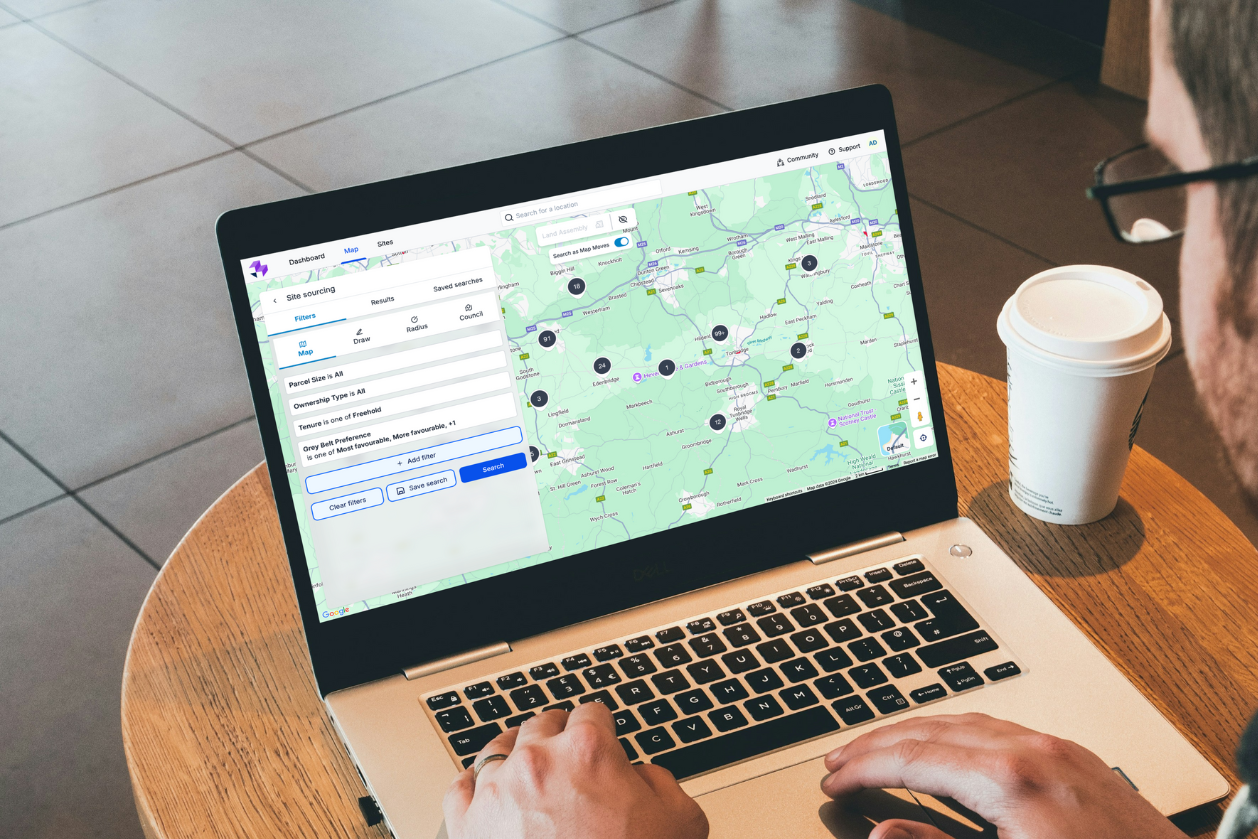
LandInsight brings together opportunity mapping, constraint overlays, planning history, precedent analysis, and pipeline management in one place - so developers can see which areas show active development signals, overlay environmental and policy constraints, review nearby planning decisions, and keep sites organised within a structured pipeline.
Instead of switching between portals and spreadsheets, you get a clear, consolidated view of risk and potential at every stage. Faster decisions. Fewer late-stage surprises. A sourcing process that actually scales.
See how LandTech can help you avoid planning delays.

FAQs
What is the 2% rule for property?
A buy-to-let investor's rule of thumb - monthly rental income should equal at least 2% of the purchase price. For developers, it's largely irrelevant. Development-led site sourcing is about planning probability, deliverability, and value uplift, not rental yield.
What is the property sourcing process?
For developers: identify potential sites, screen constraints, assess planning risk, analyse local authority behaviour, review precedent, and prioritise based on probability and value. It's a structured decision-making workflow, not a search exercise.
What does property sourcing mean?
Identifying and evaluating property opportunities for acquisition or development. In a development context, that means assessing whether land can realistically secure planning permission and generate viable value - before you commit significant resource to finding out the hard way.
How much do property sourcers charge?
Fees vary. Buy-to-let sourcers typically charge 2–5% of the purchase price. Development-led site sourcing tends to be more bespoke, with retained search fees, success fees, or promotion agreements depending on scale and risk profile.
Is it worth using a property sourcer?
Depends on your in-house capability. If you have a disciplined screening process and access to reliable planning data, sourcing directly makes sense. If not, a knowledgeable sourcer with genuine planning insight can add real value. Either way, early assessment of planning probability remains the thing that matters most.
How hard is property sourcing?
Finding opportunities is fairly straightforward. Finding sites that are genuinely deliverable is considerably harder. Many look promising initially and fail later - planning constraints, policy conflicts, local authority resistance. Developers who apply structured screening early, reviewing constraints, planning history, and precedent before they've spent anything meaningful, are the ones who tend to build pipelines that convert.