
For property developers, strategic land promoters, and investors, accurate development appraisals hinge on one critical variable: time.
Forecasting how long planning permission will take is essential for calculating holding costs, structuring finance, and projecting a realistic return on investment.
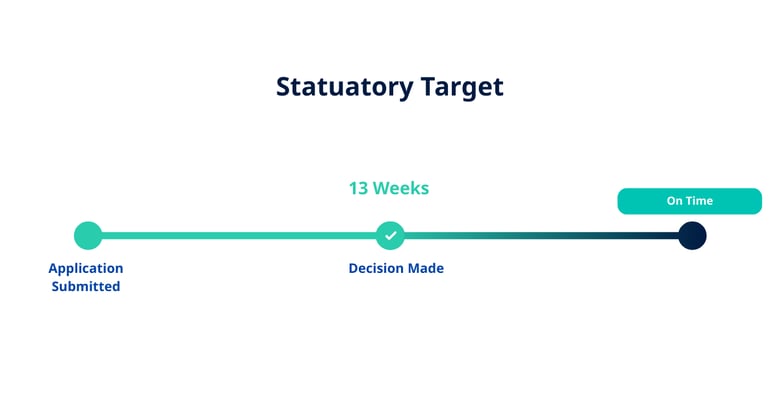
The statutory target for determining major planning applications in England is 13 weeks (or 16 weeks where an Environmental Impact Assessment is required). For non-major applications, the target is 8 weeks.
However, anyone active in the current market knows there is a significant disconnect between official targets and real-world experience.
To understand how long planning actually takes heading into 2026, we analysed the latest determination period data from the Ministry of Housing, Communities and Local Government (MHCLG), cross-referencing it with LandInsight by LandTech data drawn directly from local planning authority portals.
Here’s what the data really shows.
Key Highlights
- Statutory targets vs reality: Only 19% of major applications are genuinely decided within 13 weeks.
- Reliance on extensions: Around 71% of major applications depend on Extensions of Time (EoTs) or Planning Performance Agreements (PPAs) to be recorded as “on time”.
- Postcode lottery: Average determination periods vary dramatically by region, with some councils taking nearly a year to determine major schemes.
- Financial risk: Miscalculating a timeline by six months can materially erode development margins through compounded holding costs.
What Are the Standard Planning Determination Periods?
In England, statutory planning determination periods are set out in Article 34 of the Town and Country Planning (Development Management Procedure) (England) Order 2015 (as amended).
These define how long a local planning authority (LPA) has to determine a planning application once it has been validated.
The standard periods are:
|
Application Type |
Statutory Determination Target |
|
Non-Major Applications |
8 Weeks |
|
Technical Details Consent |
10 Weeks |
|
Major Development |
13 Weeks |
|
EIA Required Applications |
16 Weeks |
Note: The "Planning Clock" begins from validation, not submission. Time spent resolving validation queries does not count toward these statutory targets.
Why Official Planning Statistics Can Be Misleading
If you look at headline government statistics alone, the system appears efficient. For the quarter July to September 2025, MHCLG reported that 90% of major applications were determined “on time.”
But “on time” does not mean within 13 weeks. It includes applications determined within an agreed Extension of Time (EoT) or Planning Performance Agreement (PPA).
When you strip out EoTs and look strictly at statutory timeframes, the picture changes dramatically.
In Q3 2025:
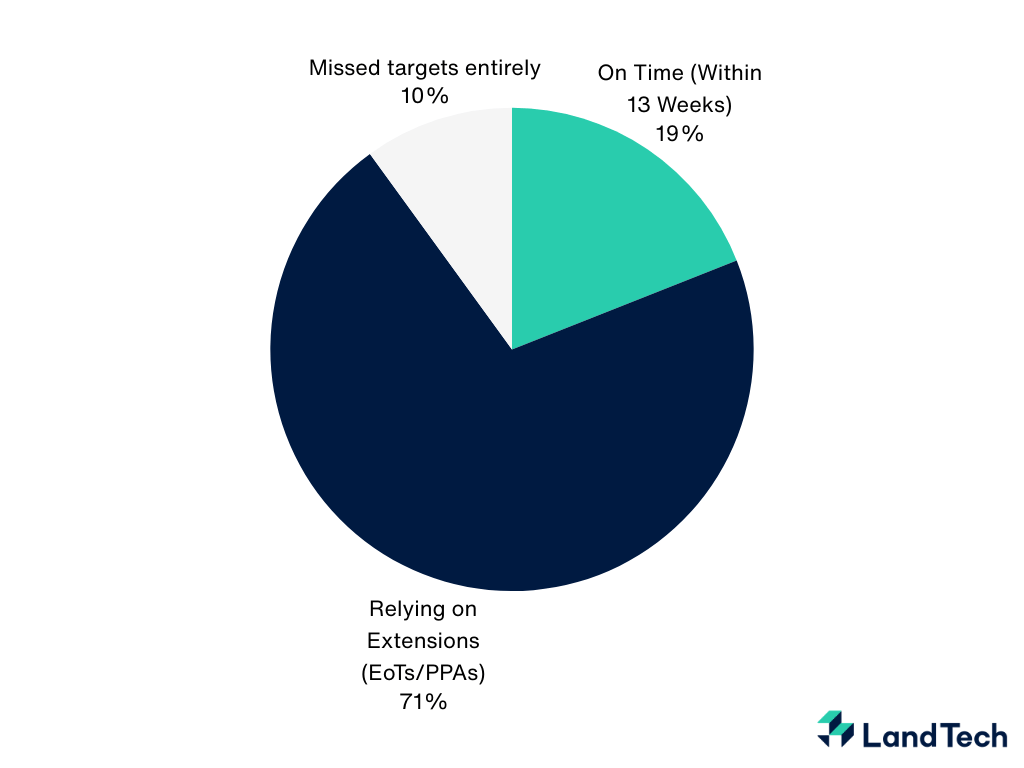
- Only 19% of major applications were determined within 13 weeks
- Approximately 71% relied on EoTs or PPAs
- 10% missed targets entirely, even with extensions
In other words, more than 80% of major applications exceed the statutory baseline.
The Role of Extension of Time (EoTs)
The most common reason planning determination periods extend beyond statutory limits is the widespread use of Extensions of Time.
As officers approach the end of the statutory window, applicants are frequently asked to agree to additional time. If agreed in writing, the decision can still be recorded as “on time”.
Importantly, multiple EoTs can be agreed on the same application.
This means a scheme that should take 13 weeks can extend to 9, 12, or even 18 months - yet still appear compliant in performance tables.
While EoTs often reflect genuine workload pressures and application complexity, their routine use makes headline statistics a poor proxy for real-world planning timelines.
.png?width=1200&height=628&name=Application%20Submitted%20(1).png)
Regional Performance and the Postcode Lottery
Planning is inherently local.
National averages flatten extreme regional disparities. Our analysis reveals a severe postcode lottery, where geography alone can add months to a planning timeline.
We tracked mean determination weeks for major applications across England and found:
- In faster-performing regions, averages hover around 30 weeks
- In slower regions, averages stretch past 40 weeks
- At individual council level, some LPAs average 50+ weeks - nearly a year
Crossing a regional boundary can materially alter your programme assumptions.
National data tells you the target. Local data tells you the risk.
The 2026 Reality Check
In 2022, LandTech identified that fewer than 30% of major applications were actually determined within the 13-week period. Fast-forwarding to 2026, the gap between statutory targets and operational reality has widened.
Compared to 2022, the proportion of applications genuinely determined within 13 weeks has fallen, while regional disparities have increased.
So What Has Actually Changed?
Three things stand out:
- Greater reliance on Extensions of Time. EoTs are now firmly embedded as standard practice rather than exceptional measures.
- Wider regional disparity. The gap between the fastest and slowest LPAs has widened, increasing geographic planning risk.
- More visibility, but not necessarily faster decisions. Planning delays are now widely acknowledged, and councils more often distinguish decisions made with and without EoTs. However, transparency has not translated into materially shorter determination periods.
In other words, the structural issue identified in 2022 has not been resolved. If anything, the gap between statutory targets and operational reality has widened.
For developers modelling schemes in 2026, this means one thing: a 13-week assumption is now more detached from reality than it was three years ago.
The Financial Cost of Getting it Wrong
So why does this matter?
Because development appraisals are built on time assumptions.
If you model a 13-week planning phase but the real determination period stretches to 12 months, the financial impact compounds quickly:
- Interest accrues on bridging and acquisition finance
- Professional fees continue during negotiations
- Equity remains tied up
- Start-on-site dates are pushed back
- Exposure to build cost inflation increases
- GDV risk rises in volatile markets
In a margin-sensitive environment, underestimating the planning determination period is one of the fastest ways to turn a viable site into a loss-making one.
Why Developers Must Understand Planning Determination Periods in Practice
Statutory targets remain important - they define the legal framework and underpin performance monitoring.
Where LPAs consistently fail to meet targets, they risk special measures and intervention by the Planning Inspectorate.
There is also a government “planning guarantee” that decisions should normally be issued within 26 weeks where no EoT is agreed.
But these mechanisms do not prevent extended timelines where extensions are routinely used.
For developers, understanding real-world determination periods helps to:
- Stress-test financial appraisals
- Anticipate holding costs
- Compare planning risk across multiple sites
- Make better-informed acquisition decisions
Planning risk is not evenly distributed; it varies significantly by LPA and region. Managing that risk starts with better data.
From Assumptions to Evidence: Use Real Planning Data with LandInsight
To safely appraise a site in 2026, developers must look beyond national targets and examine historical determination data for their specific operating areas.
LandInsight’s Planning Application layer allows you to:
- Benchmark LPA performance
- Monitor live applications and status changes
Instead of relying on statutory deadlines, you can base assumptions on real-world evidence and price risk accordingly.
FAQ's About Planning Determination Periods
What is the planning determination period?
The planning determination period is time taken from the validation of a planning application up to the point that a decision is made. There is a statutory timeframe within which a local planning authority is expected to make a decision on a valid planning application.
In England, this is typically:
- 8 weeks for minor applications
- 13 weeks for major applications
- 16 weeks for applications requiring EIA
The period begins at validation, not submission. It can be extended by agreement through an Extension of Time.
What does “determined” mean on a planning application?
An application is considered determined when the local planning authority issues a formal decision - approval (with or without conditions) or refusal.
An application determined within an agreed EoT is still recorded as “on time” in official statistics, even if the overall process took significantly longer than the original statutory window.
Stop guessing and start de-risking your next site. See the true determination periods and historical approval rates for any site in seconds.
Stop guessing and start de-risking your next site. See the true determination periods and historical approval rates for any site in seconds.