
Planning appeals are rarely anyone’s first choice. But for many developers, they’re an all-too-familiar part of working within a planning system where decisions stall, objections escalate, and certainty is hard to pin down.
The good news is that our friends at the Planning Inspectorate publish detailed statistics each year, giving us a clear picture of how long different types of appeal take, and what tends to slow things down.
Using the Planning Inspectorate statistical release from 22nd November 2025, this article looks at what developers should realistically plan for when appeals enter the picture.
Key Highlights
- Appeal times are shaped by a small number of consistent factors, with procedure type and appeal complexity doing most of the work
- Written representation appeals remain the quickest and most predictable route
- Hearings and inquiries add several months and should be treated as a material programme risk
- Enforcement appeals take significantly longer, reflecting their inherent complexity
- Recent trend data shows modest improvement in decision times, not deterioration
.png?width=1200&height=1200&name=Is%20an%20appeal%20worth%20it%20(1).png)
How Common Are Planning Appeals?
Planning appeals make up the largest share of appeal decisions in England. In the year ending March 2025, they accounted for around 57% of all appeal decisions, far outweighing other appeal types. Householder appeals followed at just under a quarter, while enforcement appeals represented a much smaller proportion.
However, it is important to keep this in perspective. National data from the Planning Inspectorate shows that only around 6% to 7% of planning applications are appealed in the first place. Of those decisions, approximately 2% to 3% are overturned.
So while planning appeals dominate the appeals system itself, the vast majority of planning applications are still determined at local authority level without progressing to appeal.
That said, for developers working at scale, or regularly promoting complex or policy sensitive sites, encountering the appeals process at some point remains a realistic possibility.
|
Year |
Total major decisions and non-determined cases |
Total major appeal decisions |
Major decisions overturned at appeal |
% of Major applications that get appealed |
% of decisions overturned |
|
2019 |
13930 |
769 |
264 |
6% |
2% |
|
2020 |
12073 |
853 |
322 |
7% |
3% |
|
2021 |
12083 |
812 |
322 |
7% |
3% |
|
2022 |
11618 |
798 |
351 |
7% |
3% |
|
2023 |
10992 |
746 |
338 |
7% |
3% |
|
2024 |
10427 |
637 |
340 |
6% |
3% |
A Quick Overview of the Planning Appeal Process
You can submit a planning appeal if:
-
Your application is refused (or approved with conditions you disagree with)
- No decision is made in time
- 8 weeks for most applications
- 13 weeks for major development
Planning appeals are decided one of three ways:
|
Written representations
|
Hearings
|
Inquiries
|
Who Makes the Call?
While you can state which procedure you think is appropriate and your LPA can make a recommendation, the Planning Inspectorate makes the final call, based on the complexity of the issues and how much debate is needed.
How Does the Appeal Process Affect Turnaround Time?
Median turnaround time of appeal procedures (B - dataset)
|
Appeal procedure |
Median turnaround time of planning appeals (weeks) |
|
Written reps |
16 weeks |
|
Hearings |
22 weeks |
|
Inquiries |
31 weeks |
The data on this one is clear - the procedure used to determine an appeal has a predictable impact on timelines.
Appeals dealt with by written representations tend to be quickest, but once a case moves to a hearing or inquiry, a more significant delay should be expected.
In other words, procedure choice is not just an administrative detail. It’s one of the strongest indicators of delay.
How Long Do Planning Appeals Take?
Median turnaround time of appeal types (C - dataset)
|
Appeal type |
Median decision time (weeks) |
|
Household Appeals (written) |
12 |
|
Planning Appeals (written) |
16 |
|
Enforcement Appeals (written) |
63 |
For this comparison, we have focused on written appeals, as this is the situation developers are most likely to encounter. As you can see, planning appeals are not the quickest part of the system, but they are far from the slowest.
Still, adding roughly four months to a project is significant and likely very costly. More robust early-stage planning can help developers better understand constraints, risks, and potential objections earlier in the process. This reduces the likelihood of appeals and, at the very least, allows developers to enter the process with clearer expectations.
Are Planning Appeals Taking Longer Than They Used To?
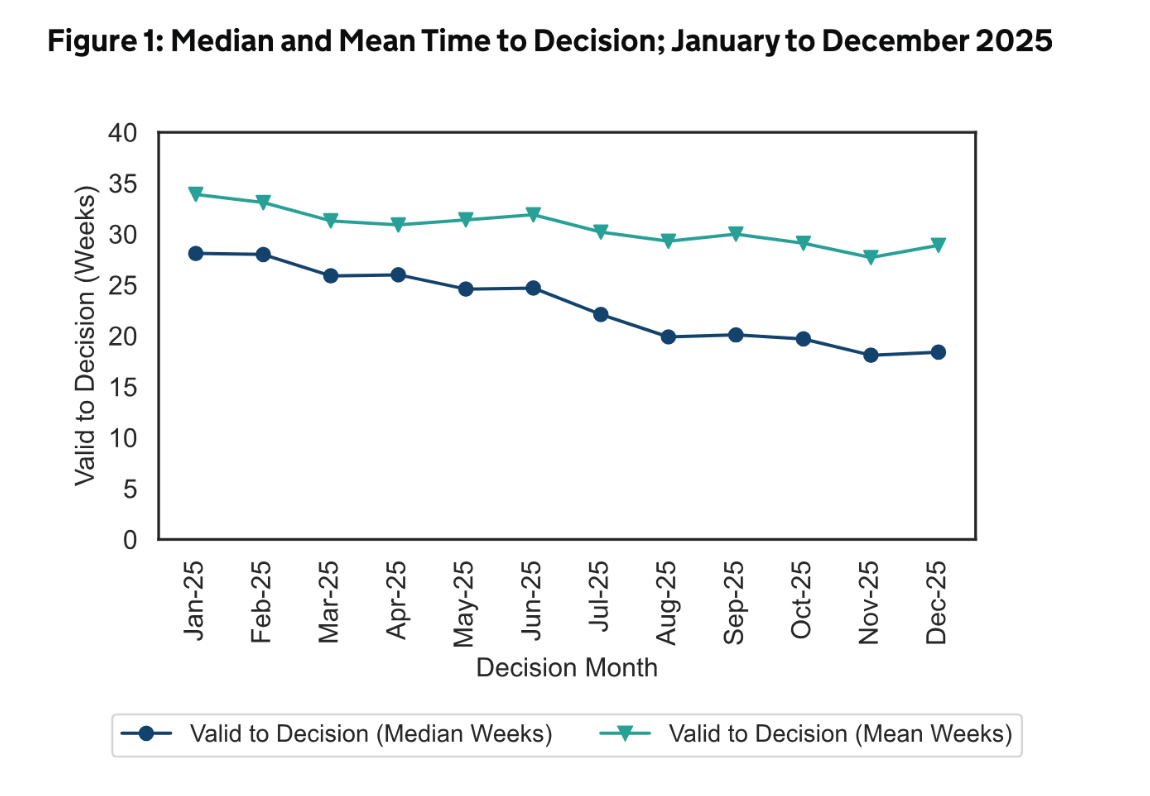
Source: Planning Inspectorate statistical release 22 November 2025
Whilst decision time has tended to remain fairly stable when compared to our earlier analysis, trend data from the latest release shows a slight reduction in median decision times over the past year. This is a positive sign, indicating that the appeal system is more likely to be improving than deteriorating.
Why Do Some Planning Appeals Take Longer Than Others?
Based on Planning Inspectorate data, delays tend to be driven by a small number of recurring factors:
Procedure Type
Hearings and inquiries take longer by design. The data shows clear step-changes in timescales as cases move from written evidence to more formal examination.
Complexity of Issues
Appeals involving multiple policy issues, technical evidence, or significant public interest require more written evidence, more time for examination, and often longer Inspector availability.
Changes During the Appeal
Requests for additional information, amended plans, or procedural changes can extend timelines, particularly where system capacity is under pressure.
What Should Developers Realistically Plan For?
Planning appeals will delay a project, even in relatively straightforward cases. For most planning appeals, a decision is likely to take around 16 weeks, with much longer lead times where hearings, inquiries, or enforcement are involved.
The strongest predictors of delay are the procedure required and the complexity of the issues under consideration. That means uncertainty tends to arise where policy conflict, technical evidence, or public scrutiny has not been fully worked through upfront.
In practical terms, this means building contingency plans and stress-testing assumptions early. Appeals may be part of the system, but surprises don’t have to be. Better early-stage site assessment helps developers identify constraints sooner, anticipate points of contention, and make informed decisions about timing and risk.
Understanding where delay is most likely to arise is often the difference between a manageable impact and a costly one.
See how LandInsight can help you avoid planning delays.