

Class MA permitted development is the most flexible, and commercially valuable, route for converting existing commercial buildings into homes. For developers, bypassing full planning permission drastically reduces planning risk and holding costs. It lets you get to site faster, recycle capital quicker, and typically avoid Section 106 affordable housing contributions, which directly protects your margins.
However, Class MA isn't a straightforward "tick-box" route. Every scheme goes through prior approval, and local planning authorities (LPAs) scrutinise site-specific factors such as natural light, flood risk, noise, highways, fire safety, and the impact on important industrial areas.
Understanding both the eligibility rules and the prior approval requirements is the difference between a smooth conversion and months of delays, refusals, or wasted effort.
In this guide, we give you a practical, technical overview of commercial to residential permitted development under Class MA. We cover why the right exists, which buildings suit it, the eligibility checklist, common pitfalls, the pros and cons, and how to prepare a robust submission. For the wider picture on every PD class, see our complete guide to permitted development rights.
Key Highlights
- Class MA allows a change of use from Class E (commercial, business and service) to Class C3 (dwellinghouses) without a full planning application, subject to prior approval.
- Since March 2024, there is no floorspace cap and no vacancy requirement. The building still needs two years' continuous Class E use before you apply.
- The right doesn't apply to listed buildings, scheduled monuments, SSSIs, National Parks, National Landscapes (AONBs), the Broads, World Heritage Sites, safety hazard or military explosives areas, or agricultural tenancies without consent.
- LPAs assess nine prior approval matters, including natural light, noise, flood risk, conservation areas (for ground floor changes), and fire safety for taller buildings.
- LPAs have 56 days to decide, and you must complete the conversion within three years of the prior approval date.
- Article 4 directions can remove Class MA rights locally, so screen for emerging directions as well as active ones.
The Legal Basis: What Class MA Actually Permits
Class MA is a permitted development right in the General Permitted Development Order (GPDO) that allows certain commercial buildings to change to residential use, subject to prior approval. It's the main route for permitted development commercial to residential conversions in England.
Class MA permits:
- The change of use of a building from Class E (commercial, business and service) to Class C3 (dwellinghouses), as set out in Schedule 2, Part 3, Class MA of the GPDO
Eligible buildings include offices, shops, cafés and restaurants, gyms, clinics, nurseries, and light industrial units. In other words, most of the uses grouped into Class E.
However, the right isn't automatic, and applications can be refused where eligibility or prior approval matters aren't properly addressed.
Class MA doesn't apply to buildings or sites that are:
- Listed buildings or within their curtilage
- Scheduled monuments
- Sites of Special Scientific Interest (SSSIs)
- Within a safety hazard area or military explosives storage area
- Within a National Landscape (formerly Area of Outstanding Natural Beauty), a National Park, the Broads, a World Heritage Site, or an area specified under section 41(3) of the Wildlife and Countryside Act 1981
- Occupied under an agricultural tenancy, unless both the landlord and tenant have given express consent
Class MA permitted development rights can unlock significant residential potential, but only where you fully assess eligibility and the likelihood of prior approval.
Which Projects Need Permission?
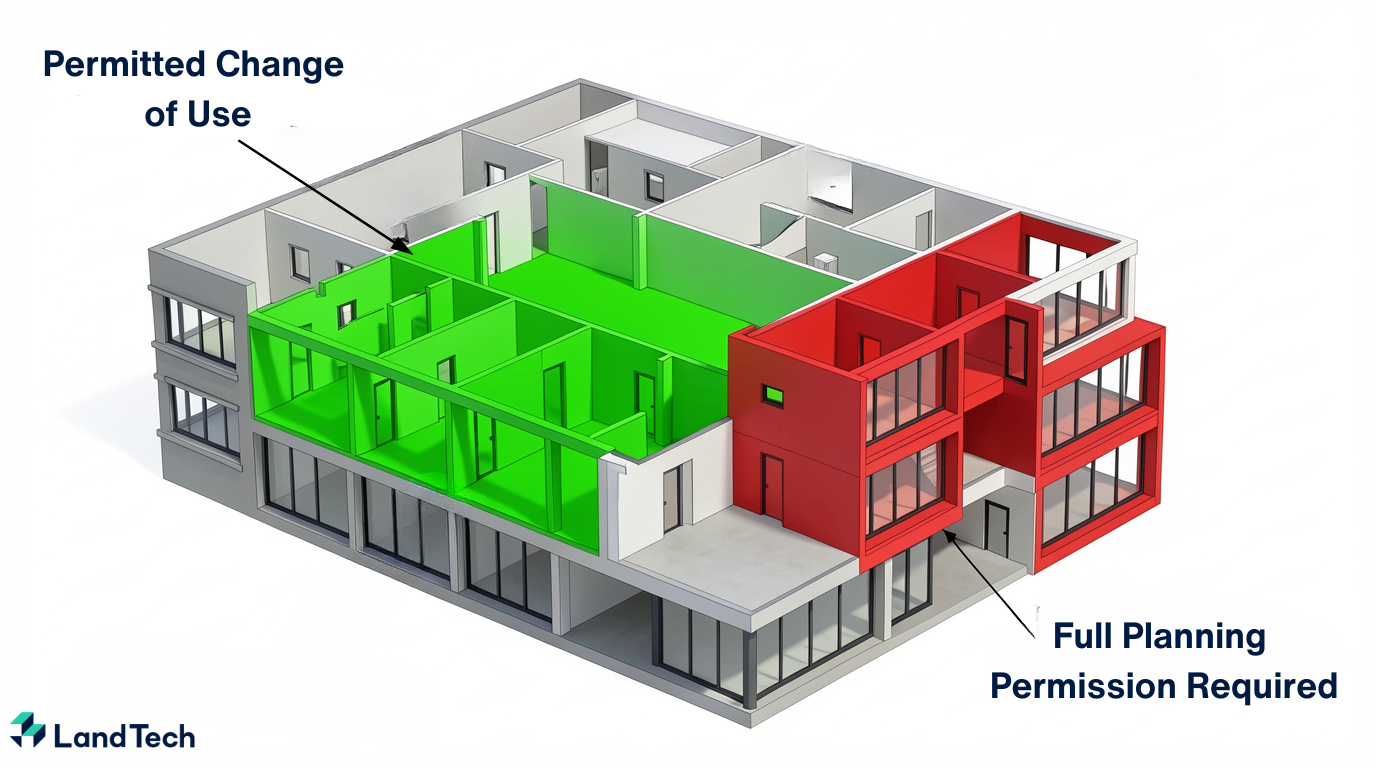
Class MA is strictly a change of use right. It doesn't grant blanket permission for physical development, so any works beyond internal reconfiguration generally need a full planning application. Examples include:
- Extensions or additional storeys
- Significant external alterations affecting the building's appearance
- Material changes to access, servicing, or layout
- Works conflicting with other planning policies or design controls
Why Class MA Exists and Why It Matters Now
Class MA came into force on 1 August 2021. It consolidated earlier permitted development rights for offices, shops, and light industrial buildings (including the office-to-residential Class O) into a single route from Class E to Class C3.
The aim was to bring underused commercial floorspace back into use, deliver homes where they're needed, and give struggling high streets and secondary town centres a new lease of life.
The 2024 amendment order made Class MA considerably more flexible by:
- Removing the 1,500 m² floorspace cap, so larger commercial buildings can now be converted
- Removing the three-month vacancy requirement, so occupied premises can now be considered
Together, these changes widened the pool of eligible buildings and gave developers more options in high-demand residential areas.
Official housing supply data shows how much permitted development has contributed to housing delivery over the past decade. Delivery through PD peaked in the mid-2010s, driven largely by office-to-residential conversions, which reached 17,751 homes in 2016/17.
Since then, volumes have fallen, with total permitted development change of use delivering 7,681 homes in 2024/25. That reflects tighter controls, changing market conditions, and the retirement of earlier rights such as Class O.
But the numbers linked to Class MA are heading the other way. Homes delivered from commercial, business, and service uses more than doubled in two years, from around 450 in 2022/23 to 803 in 2023/24 and 1,048 in 2024/25.
It's still a small number compared with the office conversion boom, but the upward trend suggests Class MA is becoming a meaningful route to new homes and to meeting local housing targets.
Developer tip: More buildings are now in scope in theory, which makes early filtering more important, not less. Article 4 directions, heritage designations, environmental constraints, and prior approval matters still decide whether a conversion is viable.
Which Buildings and Locations Suit Class MA?
Class MA works best where a building's existing form and services already lend themselves to residential use. Typical winners include:
- Secondary or tertiary retail parades with surplus or underused units, often on high streets or local shopping streets. Think upper floors above convenience stores, or redundant bank branches in neighbourhood centres where footfall has dropped but residential demand is still strong.
- Edge-of-centre offices in areas with strong residential values and a setting that suits housing. Low-rise office blocks just outside primary retail cores, or former professional services offices near transport hubs, are good examples. This is where permitted development office to residential schemes tend to stack up best.
- Standalone Class E buildings, including gyms, clinics, and light industrial units. Former health centres, fitness studios, or small trade units on the edge of residential areas can work well, particularly where buildings have good floor-to-ceiling heights, multiple elevations for natural light, and straightforward access to utilities.
When assessing potential sites, look beyond use class alone and consider:
- Building suitability: Structural layout, ceiling heights, floorplate depth, and access for residential use.
- Local constraints: Article 4 directions, conservation areas, flood risk, noise sources, and other restrictions set by the LPA.
- Market factors: Demand indicators, local residential values, and the likely uplift from conversion.
- Environmental factors: Flood risk, contamination, and access arrangements can all trigger extra scrutiny or limit what can be approved.
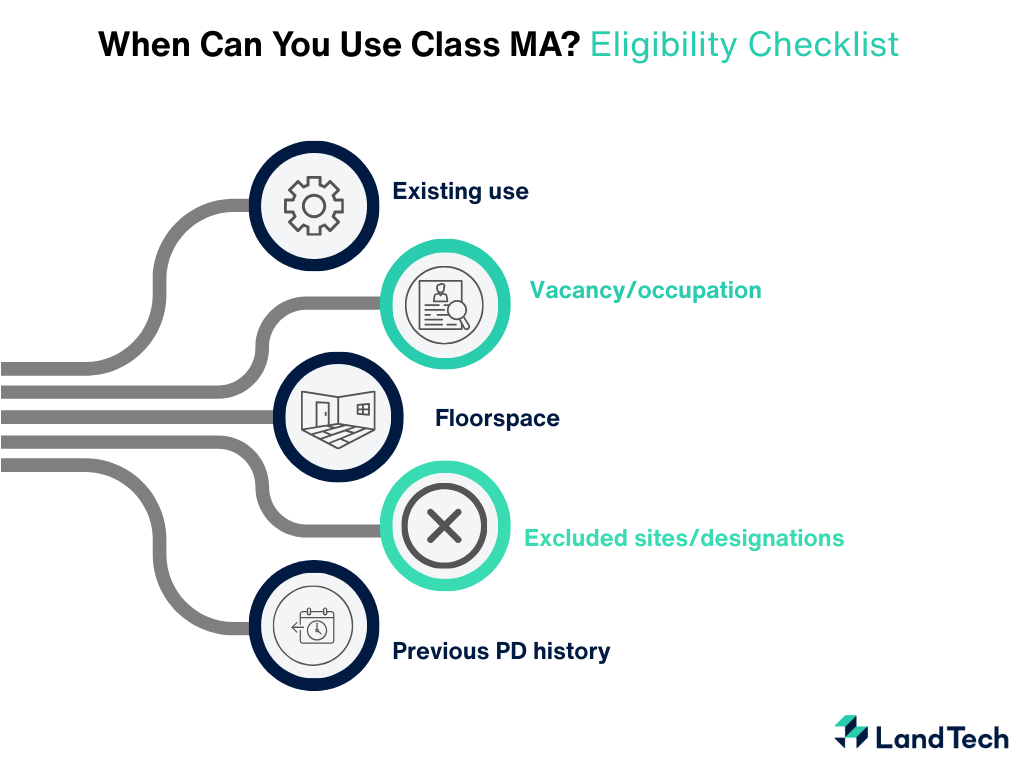
When Can You Use Class MA? Eligibility Checklist
Class MA became significantly more attractive in March 2024, when both the floorspace cap and the vacancy requirement were removed. The pool of eligible buildings is now broader, but eligibility remains tightly defined.
Below is a concise checklist of the key conditions LPAs assess.
Existing Use
The building must have been in Class E use continuously for at least two years before the application. Eligibility is determined by lawful use, not building form or marketing description.
LPAs verify this through:
- Planning permissions or lawful development certificates
- Business rates records
- Lease or tenancy agreements
- Utility bills or operational records
Vacancy/Occupation
Previously, buildings needed at least three months’ vacancy to qualify. That requirement was removed in 2024.
Now, legally, buildings no longer need to be empty, and ongoing occupation doesn’t disqualify a site. Commercially, this is a massive cash-flow victory. Developers can acquire income-producing assets and collect commercial rent while preparing their prior approval submissions, bypassing the need to engineer a risky vacancy period.
Practically, however, active tenancies or operational uses can affect:
- Timing of implementation
- Clarity of evidence for existing use
- How LPAs interpret current function
So early review of occupancy is recommended, even though vacancy is no longer a strict eligibility test.
Floorspace
The removal of the 1500 m2 floorspace cap was a significant expansion of Class MA.
- No maximum size limit now applies
- Larger offices, retail units, and commercial premises can now qualify in principle
All buildings, regardless of scale, remain subject to the other statutory tests and local controls, such as designations and Article 4 directions. Every new home must also meet the nationally described space standard, which applies to all permitted development homes.
Excluded Sites/Designations
Some sites are excluded from Class MA outright:
- Listed buildings or land within their curtilage
- Scheduled monuments
- SSSIs
- Safety hazard areas or military explosives storage areas
- National Landscapes (AONBs), National Parks, the Broads, World Heritage Sites, and areas specified under section 41(3) of the Wildlife and Countryside Act 1981
- Sites occupied under an agricultural tenancy, unless the landlord and tenant have both given express consent
Conservation areas aren't excluded, but a ground floor change of use there triggers an extra prior approval matter (see below).
On top of this, Article 4 directions allow LPAs to remove permitted development rights in defined areas, such as town centres, conservation areas, or key employment locations.
Previous PD History
What has happened on the site in the past also affects eligibility. In some cases:
- Previous permitted development changes of use may restrict further use of Class MA
- Conditions attached to earlier approvals can limit future flexibility
- Past enforcement action or unresolved breaches can affect eligibility
These issues are often site-specific and not obvious from current use alone. Two buildings that look identical today can have very different outcomes because of their planning history. They often only come to light when the history is examined in detail, but they can decide whether Class MA is available in practice.
Prior Approval for Class MA: What LPAs Consider
Prior approval is a formal, evidence-led assessment. The LPA can only consider the specific matters set out in the legislation, but it will look at each one closely to decide whether residential use is appropriate for the building and its context.
Many refusals come down to poorly addressed or unsupported prior approval matters. Here's what LPAs evaluate, so you know what to target in your submission:
- Transport impacts: Particularly whether the site has safe access. LPAs also look at parking, servicing, and emergency routes, and may consider cumulative traffic from multiple schemes.
- Contamination risks: Historic commercial or industrial uses can leave soil or groundwater contamination. A desk study or Phase 1 report is usually needed to show risks are understood and can be mitigated.
- Flooding risks: Sites in flood-prone areas need an assessment of flood zones, mitigation measures, and the safety of future residents.
- Noise from commercial premises: Future residents must be protected from noise from nearby industrial, commercial, or night-time economy uses. Mitigation can include insulation, layout, or operational measures.
- Conservation areas: Where the site is in a conservation area and the change of use involves all or part of the ground floor, the LPA considers the impact on the character or sustainability of the conservation area.
- Adequate natural light: All habitable rooms must receive adequate natural light. Over-deep or heavily subdivided layouts are a common reason for refusal, and a daylight study against recognised standards (such as BRE guidance) is the usual way to show compliance.
- Important industrial areas: Where the building sits in an area the LPA considers important for general or heavy industry, waste management, storage and distribution, or a mix of these, the LPA assesses the impact on future residents of introducing housing there.
- Loss of nursery or health centre services: Where the building is a registered nursery or an NHS health centre, the LPA considers the impact of losing that service on local provision. Evidence of alternative provision nearby helps here.
- Fire safety: Where the building meets the fire risk condition (broadly, taller buildings containing two or more homes), the LPA assesses the fire safety impacts on future occupants. The Building Safety Regulator is consulted on these applications.
Key takeaway: Prior approval decisions hinge on how well you assemble evidence and address risk. Submissions that anticipate LPA concerns, provide site-specific data, and clearly explain mitigation are far more likely to succeed.
Common Reasons Class MA Applications Are Refused (And How to Avoid Them)
Refusals are more common than many developers expect. In April to June 2026, around one in five permitted development prior approval decisions were refusals across all PD classes. Here are six common issues with Class MA applications and how to avoid them.
|
Reason |
How to avoid it |
|---|---|
|
Inadequate evidence of lawful Class E use for the required period |
Confirm the building's Class E use history early and assemble clear evidence covering the full two-year period. Don't rely on a single document or assumptions about current use. |
|
Poor natural light or substandard unit sizes |
Test proposed layouts against recognised daylight standards and the nationally described space standard. Avoid over-subdivision that creates cramped or deep habitable rooms. |
|
Unresolved flood or contamination risks |
Screen sites for flood zones and historic land uses. Submit proportionate technical evidence, such as a flood risk assessment or contamination desk study, with the application. |
|
Noise and amenity issues not addressed |
Assess surrounding uses, particularly industrial activity and the night-time economy, and show how you'll mitigate noise. |
|
Loss of a nursery or health centre without justification |
Check whether the existing use is a registered nursery or NHS health centre. If it is, provide evidence on local provision. |
|
Conflicts with Article 4 directions or technical ineligibility |
Check Article 4 coverage and site designations at the outset, and make sure the application area matches where Class MA rights still apply. |
Key takeaway: There’s a common pattern across these refusal themes. Applications fail where eligibility is assumed rather than demonstrated, or where prior approval risks are discovered too late. Early screening and targeted evidence are key here.
The Pros and Cons of Class MA
Class MA offers a clear route for converting commercial buildings into homes, but it isn't the right approach for every site. It works best when you can deliver good-quality homes without extensive structural changes.
If you want to add extensions or extra floors, reclad the building, create a mixed-use scheme, or have more control over unit mix, amenity space, or layout, a full planning application may be the better route.
Advantages
- A quicker, more certain route: Class MA relies on prior approval rather than a full planning application. That usually means shorter determination times and less planning risk, so you know sooner whether a scheme can go ahead.
- Better viability in many cases: Class MA schemes typically avoid Section 106 affordable housing contributions. That can make smaller, constrained, or lower-value sites deliverable where a fully policy-compliant scheme would struggle to stack up.
- Unlocking value from underused space: Converting surplus Class E floorspace to residential can significantly uplift land and building value, and reuses existing buildings rather than relying on new build.
Developer tip: Avoiding S106 doesn't mean avoiding the Community Infrastructure Levy (CIL). Class MA schemes can still be liable. But where the building has been in lawful use, you can often offset existing "in-use" floorspace against your CIL liability, which can make a real difference to your bottom line. Check the detail with your CIL adviser early.
Constraints
- Less design flexibility: Class MA covers the change of use only. External works, such as new doors or windows, may need separate permission unless another PD right covers them. That limits how far you can reconfigure layouts, optimise the unit mix, or improve the building's appearance compared with a full planning application.
- Amenity and environmental issues: Noise, daylight, and access to private or shared outdoor space can be harder to resolve in existing commercial buildings, particularly in busy town centre or edge-of-centre locations.
- Local restrictions still apply: Article 4 directions can remove Class MA rights in specific areas, meaning you'd need a full planning application instead.
Developer tip: Don't just screen for active Article 4 directions. Look for emerging ones too, as some LPAs introduce them specifically to limit Class MA conversions. Under NPPF 2026 policy DM10, Article 4 directions that remove PD rights should be based on robust evidence and apply to the smallest area needed, which gives you grounds to scrutinise a proposed direction.
A Step-By-Step Guide to the Class MA Approval Process
Step 1: Feasibility and Data Gathering
Your first job is to establish whether the site is actually eligible for Class MA, and whether any constraints could undermine a prior approval submission.
At this stage, confirm:
- Whether the building has been in lawful Class E use for the required continuous period
- The site's planning history, including any restrictive conditions or previous refusals
- Whether the property sits within an Article 4 direction area that removes Class MA rights
- Key constraints, such as flood risk, contamination, heritage designations, or neighbouring sensitive uses
The right tool speeds this up considerably. LandTech's LandInsight platform brings these checks into one place.
You can quickly review historic and current use classes, surface Article 4 directions and local policy layers, assess flood zones, and understand surrounding land uses that may raise amenity concerns. That early visibility helps teams rule sites in or out before committing time and money.
Step 2: Prepare Your Prior Approval Package
Once you've established a site is feasible, prepare a prior approval submission that directly addresses each matter the LPA will assess.
A typical Class MA package includes:
- Existing and proposed floor plans, elevations, and site plans
- A floorspace schedule showing unit sizes and layouts (every home must meet the nationally described space standard)
- Evidence supporting each relevant prior approval matter, which may include:
- A transport or highways note
- A flood risk assessment or statement
- A contamination desk study
- A daylight and sunlight assessment
- A noise impact assessment, where relevant
- A fire statement, where the building meets the fire risk condition
Developer tip: Weak or generic supporting reports are a common reason for refusal. LPAs expect site-specific evidence that shows future residents will have acceptable living conditions.
Step 3: Submission and Determination
Once your application is validated, the LPA has 56 days to determine it.
During this period:
- The LPA may ask for clarification or more information
- Consultees (such as highways, environmental health, or the Building Safety Regulator) may raise objections that need addressing
Failing to respond promptly increases the risk of refusal.
If the 56 days pass without a decision, you may be able to appeal for non-determination. But it's usually better to resolve issues during the determination window if you can.
Once you have prior approval, the clock starts. The conversion must be completed within three years of the prior approval date.
Developer tip: Going in with a clear understanding of the assessment criteria, and anticipating likely concerns, goes a long way towards securing approval.
Find and Secure Class MA Opportunities Faster With LandInsight
Class MA permitted development opens up promising residential opportunities. But success depends on early screening, evidence-led submissions, and careful handling of prior approval matters.
Developers who treat prior approval as a real assessment, rather than a formality, are far more likely to avoid refusals and delays.
LandInsight supports this workflow from start to finish. The platform lets you:
- Identify candidate sites: Filter for Class E buildings in your chosen locations and focus on those with the greatest potential for residential conversion.
- Screen constraints early: Quickly assess flood zones, conservation areas, Article 4 coverage, and neighbouring noise or amenity risks.
- Check planning and PD history: Access historical planning applications, prior approval decisions, and enforcement records to understand risk and precedent.
- Benchmark outcomes: Review recent Class MA decisions in your target LPA to spot trends, common refusal reasons, and practical mitigation.
These insights reduce uncertainty and help you make better-informed decisions on Class MA opportunities, all within a single platform.
LandInsight can help you find and assess sites 80% faster to develop a scalable, resilient pipeline.

FAQs About Class MA Permitted Development
What does Class MA mean in property?
In property and planning, "MA" is the reference for a specific permitted development right in the General Permitted Development Order. It isn't an abbreviation. The legislation heads Class MA "commercial, business and service uses to dwellinghouses", and it allows a change of use from Class E to Class C3, subject to conditions and prior approval. It's essentially the legal route for Class E to resi conversions.
What is Class MA natural light?
One of the prior approval matters for Class MA is making sure every habitable room in the new homes gets adequate natural light.
LPAs usually assess this against recognised daylight standards, such as the Building Research Establishment (BRE) guidelines, to make sure future residents have acceptable living conditions. Poor natural light is a common reason for refusal where layouts are deep, over-subdivided, or obstructed.
Has Class MA replaced Class O?
Yes, Class MA effectively replaced Class O. Class O only allowed office-to-residential conversions. Class MA introduced a broader route covering most Class E uses, including retail, offices, gyms, nurseries, and medical services, under a single framework.
Does Class MA apply to listed buildings?
No. Class MA doesn't apply to a listed building or land within its curtilage. To convert a listed commercial building to residential, you'd need full planning permission and listed building consent.
Does Class MA apply in conservation areas?
Yes, conservation areas aren't excluded. But where the change of use involves all or part of the ground floor, the LPA will consider the impact on the character or sustainability of the conservation area as part of prior approval. Some conservation areas are also covered by Article 4 directions, so check before you proceed.
How long do you have to complete a Class MA conversion?
You must complete the development within three years of the prior approval date.
What is classified as permitted development?
Permitted development (PD) covers changes or works that can go ahead without a full planning application. Class MA, for example, allows a change of use from a qualifying Class E building to residential (Class C3).
PD doesn't automatically cover major building works, extensions, or alterations, which may need a full planning application. PD rights can also be restricted or removed in certain locations, for example through Article 4 directions or designations such as listed building status or National Parks.
Related Reading
- Permitted Development Rights: A Complete Guide for UK Developers
- Class E and Permitted Development: Updates and Implications for Developers
- Change of Use: Planning Permission, Use Classes, and PD Routes
- Permitted Development Rights: From Class MA to Class ZA
- A Practical Guide to CIL and Planning Obligations
- Five Tips to Cut Your CIL Liability
Find Your Next Class MA Site
See how LandInsight helps you source sites and screen them for permitted development potential, from Class E use and Article 4 coverage to flood risk and planning history, in one place.