

Class MA reshapes how underused commercial buildings are assessed for residential conversion.
As town centre vacancy remains high and demand for new homes continues to outpace supply, the ability to change use from Class E to residential without a full planning application has moved from a niche option to a mainstream strategy.
For developers, land promoters, and investors, the appeal is clear: a nationally defined route, shorter timelines, and greater upfront certainty. But Class MA isn’t a shortcut to be applied hastily.
The right is tightly scoped and location-sensitive. It’s also dependent on building form, surrounding uses, and planning constraints. In the wrong context, it can restrict value rather than unlock it.
In this guide, we explain how Class MA works in practice, why it was introduced, and how recent changes have expanded its potential. We also explore which buildings tend to succeed under the right, where its limitations sit, and how data-led site assessment can help identify viable opportunities early.
Key Highlights
- Class MA has turned Class E to residential conversion into a mainstream route by offering a nationally defined framework that can reduce planning risk and timelines.
- It’s not a blanket shortcut: Class MA is tightly scoped, highly location-sensitive, and can limit value if the building form, surrounding uses, or constraints do not suit residential conversion.
- The March 2024 updates (removal of the 1500m2 cap and the 3-month vacancy requirement) widened eligibility.
- Class MA tends to work best where the existing building already has typical residential characteristics, such as edge-of-centre offices.
- Success depends on navigating prior approval impacts and balancing Class MA’s speed and viability upside against reduced design flexibility vs. full planning.
What Is Class MA
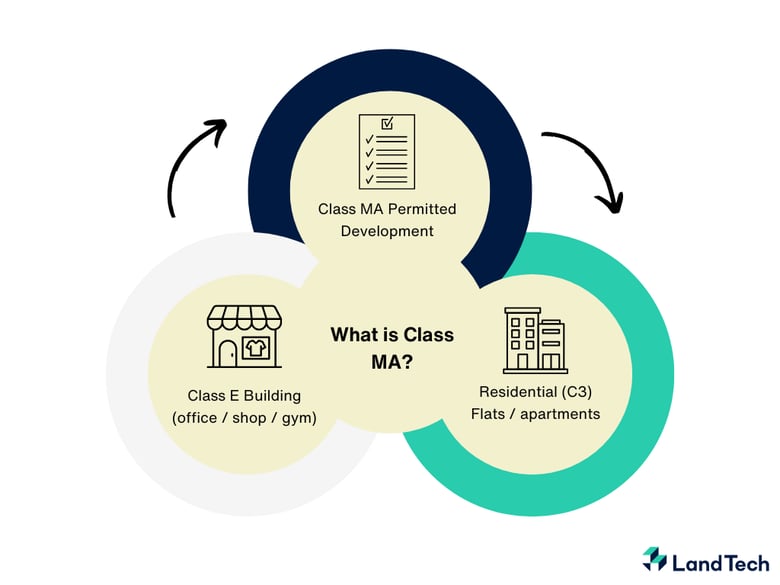
Class MA is a permitted development right (PDR) in England that allows certain Class E buildings to be converted to Class C3 residential use, subject to conditions and prior approval. It covers a broad range of Class E uses, including shops, offices, restaurants and cafés, gyms, nurseries, medical and health services, and light industrial spaces.
It sits within the General Permitted Development Order (GPDO) and provides a nationally consistent framework across England. In practice, this means that developers and investors can assess opportunities without needing a full planning application.
Developer tip: Class MA is most effective when the building’s form, structure, and existing services already align with residential use. It allows quality homes to be delivered without extensive redesign or structural work.
Key Aspects of Class MA
|
Aspect |
What it means in practice |
|
Change of use |
Converts eligible Class E commercial uses into Class C3 residential units. |
|
Permitted development |
No full planning application required, but prior approval is necessary for certain impacts. |
|
Purpose |
Supports the reuse of underused commercial floor space and the delivery of housing. |
|
Scope |
England-only; limited to buildings and sites meeting Class MA conditions. |
|
Conditions |
Prior approval is required for transport/ highways, contamination, flooding, natural light, noise, loss of community uses, and, in some cases, conservation-area impacts. Other consents (building regs, listed building consent, licensing) still apply. |
Why Class MA Exists - And Why It Matters Now
Class MA was introduced in August 2021 to consolidate earlier permitted development rights for offices, retail, and light industrial buildings. The aim was to provide a single, clear route from Class E to Class C3 residential use.
The policy aimed to support the reuse of underused commercial floor space, deliver housing where it’s needed most, and breathe new life into high streets and secondary town centres.
2024 updates made Class MA more flexible by:
- removing the 1500m2 upper floor space cap, which enables larger commercial buildings to be converted
- removing the 3-month vacancy requirement, which allows active commercial premises to be considered
Together, these changes expand the pool of eligible buildings and create more options for developers to target high-demand residential areas.
Official housing supply data shows the growing impact of permitted development rights conversions on housing supply. Delivery through permitted development peaked in the mid-2010s, driven largely by office-to-residential conversions, which reached 17,751 homes in 2016–17.
Since then, volumes have declined, with total permitted development change of use falling to 7,681 homes in 2024–25 (provisional). This reflects tighter controls, changing market conditions, and the retirement of earlier rights such as Class O.
But more recent data points to the emergence of Class MA-aligned conversions. Homes delivered from commercial, business, and service use to residential rose from 454 in 2022–23 to 803 in 2023–24, reaching 1,048 in 2024–25 (provisional).
While still smaller in scale than historic office conversions, this upward trend could point towards Class MA becoming a key permitted development route for creating residential properties and meeting housing targets.
The use of Permitted Development Rights to boost housing numbers in cities was favoured by the last Conservative Government. The current Labour government is more focussed on unlocking strategic land through changes to Green Belt protections and the introduction of grey belt as a planning mechanism. Despite this, opportunities are still there for the taking by using Class MA PDR.
Developer tip: The significance of Class MA lies in its expanded applicability. More buildings are now theoretically in scope, but that makes early filtering and constraint analysis more important. Article 4 directions, heritage designations, environmental constraints, and prior approval considerations still play a decisive role in whether a conversion is viable.
Which Buildings and Locations Does Class MA Typically Suit?
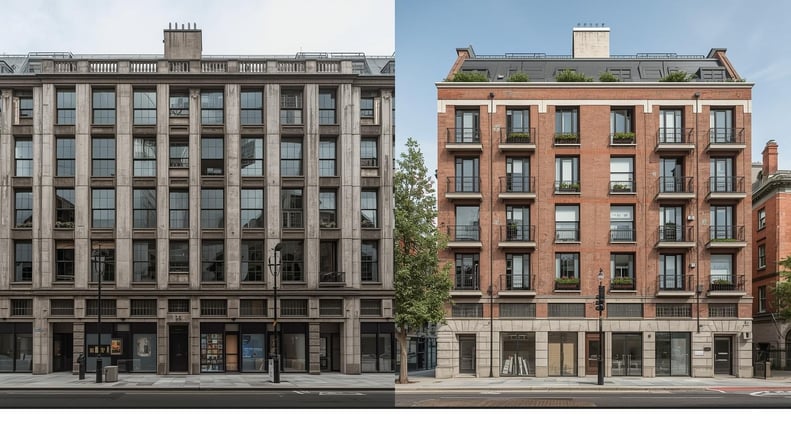
Class MA is most effective with buildings and sites where the existing form and services already align with residential use. Typical winners include:
- Secondary or tertiary retail parades with surplus or underutilised units, often found on high streets or local shopping streets. For example, upper floors above small convenience stores or redundant bank branches in neighbourhood centres where footfall has declined but residential demand remains strong.
- Edge-of-centre offices where residential values are strong and the surrounding area is suited to housing. Think low-rise office blocks just outside primary retail cores or former professional services offices near transport hubs.
- Standalone Class E buildings, including gyms, clinics, or light industrial units. For instance, former health services centres, fitness studios, or small trade units on the edge of residential areas, particularly where buildings have good floor-to-ceiling heights, multiple elevations for natural light, and straightforward access to utilities.
When assessing potential sites, you typically need to look beyond use class alone and consider:
- Building suitability: Structural layout, ceiling heights, floorplates, and access for residential use.
- Local constraints: Article 4 directions, conservation areas, flood risk, noise sources, and other planning restrictions as set by the local planning authority.
- Market factors: Demand indicators, local residential values, and the potential uplift from conversion.
- Environmental factors: Flood risk, contamination, and access arrangements can all trigger additional scrutiny or limit what can be approved.
What Are the Pros and Cons of Class MA Conversions?
While Class MA offers a clear pathway for converting commercial buildings into residential units, it’s not the right approach for every site. Permitted development opportunities depend on the building’s existing characteristics and location, as well as your goals.
Class MA works best when you can deliver high-quality homes without extensive structural alterations.
Full planning applications may be necessary if you’d like to add extensions, extra floors, wholesale recladding, or mixed-use developments. This approach is also more practical if you need greater flexibility over unit mix, amenity space, or layout.
Key Advantages
Class MA offers several practical benefits for eligible sites:
- Quicker and more certain route to development: Class MA relies on a prior approval process rather than a full planning application. This typically reduces determination times and planning risk, so you have greater certainty over whether a scheme can proceed.
- Improved scheme viability in some cases: Many Class MA developments are not subject to affordable housing or Section 106 contributions. This can make smaller, constrained, or lower-value sites financially deliverable where a fully policy-compliant planning scheme may struggle to stack up.
- Unlock value from underused commercial space: Converting surplus Class E floor space to residential can significantly uplift land and building value. It supports the reuse of existing buildings rather than relying on new-build development.
Developer Tip: While exempt from S106, your scheme may still attract the Community Infrastructure Levy (CIL). Crucially, if you can demonstrate the commercial building has been in lawful, continuous use, you can typically offset the existing 'in-use' floorspace against your final CIL liability, heavily protecting your bottom line."
Despite its benefits, Class MA has some constraints:
- Reduced design flexibility: Class MA is for the change of use only. Physical changes that don’t also fall under the scope of permitted development (generally external works such as access (doors) or fenestration (widows)) may require separate approval as a full planning permission. This can limit your ability to reconfigure layouts, optimise unit mix, or significantly improve the building’s external appearance compared with a full planning application.
- Amenity and environmental constraints: Issues such as noise, daylight, and access to private or communal amenity space can be harder to resolve within existing commercial buildings, particularly in active town centre or edge-of-centre locations.
- Local restrictions still apply: Class MA rights are not available everywhere. Article 4 directions can remove or constrain the use of Class MA and require a full planning application instead.
Developer Tip: Don't just screen for active Article 4 directions—look for emerging ones. Local Planning Authorities (LPAs) increasingly implement immediate Article 4 directions defensively to block Class MA pipelines.
What Does the Class MA Planning Process Typically Look Like?
As we mentioned, Class MA conversions are governed by the General Permitted Development Order. This allows a change of use from Class E to resi, subject to certain conditions and prior approval from the local planning authority.
Prior approval ensures that specific impacts of the development are considered without requiring a full planning application.
Key considerations for the prior approval application include the following.
|
Transport and highways |
Assessing parking, access, and traffic impact |
|
Contamination |
Ensuring sites are safe for residential use |
|
Flooding |
Evaluating flood risk and mitigation measures |
|
Adequate natural light |
Ensuring units meet minimum daylight requirements |
|
Noise and neighbouring uses |
Mitigating impact from nearby commercial or industrial activity |
|
Loss of certain community uses |
Protecting important local services in some cases |
|
Conservation and heritage impacts |
Considering where developments may affect listed buildings or conservation areas |
Additional factors may be considered during the approval process. For example, you might also need building regulations approval, listed building consent, and licensing for specific uses, if relevant.
Spot Class MA Opportunities With LandTech
Identifying viable Class MA opportunities is less about pinpointing empty shops and more about understanding risk, constraints, and residential potential at scale. And while the right itself is nationally defined, feasibility is highly local – shaped by planning policy, physical constraints, and market dynamics.
LandInsight helps bring those factors together in one place. You can identify and filter Class E buildings across chosen geographies, from town centres to edge-of-centre and suburban locations.
Then, you can layer in planning and environmental constraints, including Article 4 directions, conservation areas, flood zones, and nearby noise sources. From there, you can quickly rule out sites where Class MA is unlikely to apply.
Importantly, you can combine this planning insight with market data, such as residential values, local demand indicators, and comparable developments. With this information, it’s then possible to assess whether a conversion is not just possible but commercially viable.
For developers, investors, and land agents building future pipelines, this approach supports faster screening and more confident site selection. You can then hold better-informed conversations at the earliest stages of a project, before time and capital are committed.
LandInsight can help you find and assess sites 80% faster to develop a scalable, resilient pipeline.

FAQs About Class MA
What is a Class MA permitted development listed building?
Class MA does not apply to listed buildings. If a building is listed, permitted development rights for change of use from Class E to Class C3 are removed. A full planning application, alongside listed building consent, would be required.
This reflects the need to protect buildings of special architectural or historic interest, regardless of their existing commercial use.
What does MA mean in property?
In property and planning, “MA” refers to a specific permitted development right within the General Permitted Development Order (GPDO). Class MA allows the change of use from commercial, business, and service uses (Class E) to residential use (Class C3), subject to conditions and prior approval.
Has Class MA replaced Class O?
Yes, Class MA effectively replaced Class O. Class O previously allowed office-to-residential conversions only. Class MA introduced a broader route, covering most Class E uses, including retail, offices, gyms, nurseries, and medical services under a single framework.