

Unexpected costs can quickly derail a development project. Two common culprits are the Community Infrastructure Levy (CIL) and Section 106 (S106) agreements. Both require developers to contribute toward local infrastructure, but they operate differently.
CIL is a fixed, area-wide charge designed to fund broader local pre-agreed ‘community infrastructure’ improvements, while S106 agreements are site-specific and negotiated to address the direct impact of a particular development.
Understanding these financial obligations early is essential for accurate budgeting and avoiding costly surprises.
In this guide, we’ll explain what CIL and S106 are, outline how they interact, and show you how to assess your liability and plan smarter with advanced planning tools.
Key Highlights
- CIL is a council-set levy on most new development (often based on floorspace, location, and use) that funds wider infrastructure like roads and flood remediation.
- S106 is an agreement between the council and the developer and is negotiated and site-specific to address specific impacts arising from the development it can, cover mitigation like payments in lieu of affordable housing, access works, or off-site improvements.
- Many schemes pay both CIL and S106, so budget for a broad levy plus tailored site requirements.
- Check liability early by reviewing the LPA charging schedule, policy impacts, precedent, and any reliefs or exemptions.
- Early visibility prevents surprises, helping you stress-test viability and support funding and negotiations.
What Is the Community Infrastructure Levy (CIL)?
The Community Infrastructure Levy (CIL) is a charge that many local planning authorities (LPAs) can apply to most new developments.
It’s a way for councils to make sure that as an area grows, there’s enough funding for the local infrastructure to keep up. Think roads, schools, health facilities, parks, and community spaces.
Unlike some planning obligations, which are negotiated individually, CIL is a set rate decided by the council ahead of time, making it a relatively predictable cost.
Here are some key things to know about CIL:
- Flat-rate charge: How much you pay depends on the size, type, and location of your development. A block of flats in a busy town centre could attract a higher CIL than the same size scheme in the suburbs.
- Not always full price: Self-build homes, charitable developments, and certain other scenarios can qualify for relief exemptions.
- Funds local infrastructure: The money collected goes directly into community projects, which can include new libraries, youth centres, public transport, or park upgrades.
- Supports growth: The purpose is to ensure a new development doesn’t put too much pressure on local services.
- Separate from S106: CIL doesn’t replace other planning obligations and doesn’t usually cover site-specific requirements like access roads or drainage.
Developer tip: Getting a handle on your Community Infrastructure Levy early is strictly about protecting your bottom line. Crucially, if you are redeveloping an existing building, you can often deduct the existing 'in-use' floorspace from your final CIL calculation - provided you can prove the building has been in continuous, lawful use for a required period. This single mechanism can save tens of thousands of pounds and rescue a marginal scheme.
What Are Mayoral CILs?
Over and above standard CIL, some areas now have Mayoral Community Infrastructure Levies (MCILs). MCIL has been chargeable for certain developments in London for some time, and additional charges likely to be introduced by other mayoral authorities under the English Devolution and Community Empowerment Bill.
This gives Mayors a way of collecting funds to deliver infrastructure projects that are necessary for supporting development in their area and benefit the wider city or region. This can include transport improvements, large-scale public spaces, or regional health facilities.
If your development falls within a mayoral area, or will fall within a Mayoral area following English devolution, your local planning authority can let you know whether an MCIL applies in addition to a standard CIL.
What Are Planning Obligations (aka S106 Agreements?)
Section 106 agreements, are a direct contract between the council and the developer, where the developer promises to deliver certain things (off site works in kind, affordable housing, etc.) or make a payment to cover these works being undertaken by others. Unlike CIL, which is a standard charge, S106 agreements are site-specific and address specific issues or impacts caused by the development itself.
CIL funds go into a pot that can go towards improvements that won’t directly benefit the new development. Section 106 funds are directly related to the impact of a new development.
Here are some key things to know about S106 agreements:
- They mitigate development impacts: Their purpose is to offset the site-specific impacts of your development. For example, a new residential development may trigger requirements for affordable housing or upgrades to nearby green spaces.
- Negotiable terms: S106 contributions aren’t fixed. Your LPA will assess the impact of your development, review relevant policies, and work with you to determine what’s appropriate.
- Highly tailored: While CIL applies broadly across many developments, S106 obligations vary depending on your site and the scale of your proposed development.
- Different contributions for different sites: Even two schemes of similar size in the same town can attract very different requirements based on their unique impacts.
Developer tip: Because S106 agreements are tailored to the specifics of your development, they can influence everything from design viability to delivery timelines. Understanding your planning obligations early helps you prepare for what the council may ask of your site and ensures your development contributes meaningfully to the surrounding area.
How Do CIL and S106 Agreements Overlap and How Do They Differ?
CIL and S106 agreements both help local authorities ensure that a new development contributes to the community, but each plays a unique role. Understanding the difference can save you time and money.
Here are the similarities between the two:
- Both are linked to planning permission and only come into play when a project is approved.
- They ensure that a development project doesn’t negatively impact the local area.
- Funds from both are used to improve local services and facilities, which helps make the development acceptable in planning terms.
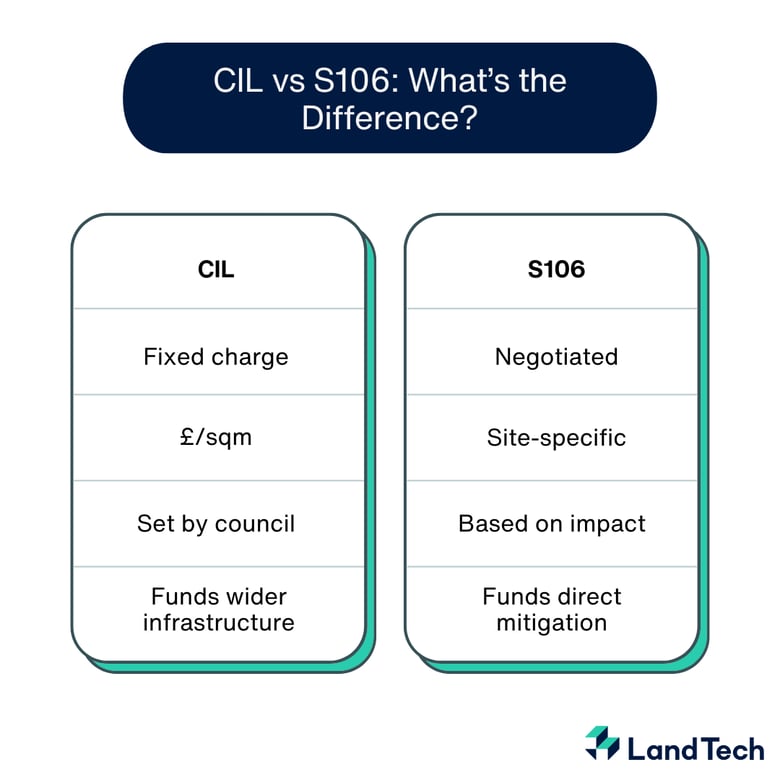
There are two key differences you need to understand:
|
Feature |
Community Infrastructure Levy (CIL) |
Section 106 (S106) Agreements |
|
Nature of Charge |
A standardised, non-negotiable flat-rate charge. |
Highly negotiable and site-specific. |
|
Calculation |
Calculation by the council per square metre of floorspace. |
Based on the direct impact of your specific development on the immediate area. |
|
Where the money goes |
Broader local infrastructure, like strategic roads and schools. |
Direct site mitigation (e.g. affordable housing, local green spaces, or specific access roads). |
- The Community Infrastructure Levy: A standardised, non-negotiable charge. It's calculated by the council per square meter of floorspace and goes toward the broader local infrastructure, like roads and schools. It’s predictable but not site-specific.
- S106 agreements: These are negotiable and tailored to the specific development impacts of your proposed project.
In some cases, your development could be subject to both charges.
For example, if you’re planning a 60-home residential scheme, you might pay CIL to support wider local infrastructure, such as a nearby secondary school or road upgrades. At the same time, the council may require an S106 agreement for on-site obligations, like creating a small park or adding parking.
Key takeaway: You can think of CIL as the big picture contribution, and S106 as the site-specific impact. You’ll need to budget for both within your project to avoid unexpected costs that could affect your bottom line.
How to Determine Whether You're Subject to CIL or An S106 Agreement
Figuring out whether your development will face CIL, S106 obligations, or both doesn’t have to be complex. Here are some steps to follow to plan your budget and avoid surprises.
- 1. Check whether the local authority charges CIL: Start by reviewing the council's charging schedule to understand the position of LPAs. Not all authorities charge CIL, and rates vary by location and the type of development. This will tell you if your project is subject to CIL and how much you may need to contribute.
- 2. Consider site-specific impacts: Look at your proposed development’s footprint, any likely strain on local services, and the local plan or policy guidance. Precedent cases in the area can also indicate what S106 obligations may be required. Data-driven appraisal tools can help you test different scenarios so you can see potential developer contributions in advance and plan accordingly.
- 3. Understand how CIL and S106 interact: Some developments are required to pay both. By analysing your obligations early, you can quantify their impact on gross development value and residual land value, which can help you make informed decisions and support evidence-based negotiations with LPAs and lenders.
- 4. Explore reliefs and exemptions: Certain developments, such as self-build homes, smaller developments, or charitable projects, may qualify for reduced rates or exemptions to cut your CIL liability.
Developer tip: Tools like LandTech’s appraisal platform let you combine planning data and site specifics to flag obligations early, which gives you a head start in discussions with LPAs and stakeholders.
How the Right Tool Can Help You Plan For CIL and S106s Early
When appraising a site, the difference between a lucrative acquisition and a stranded asset often comes down to identifying CIL and S106 liabilities before you make an offer.
With LandTech you get clear financial visibility from the start.
LandInsights' built-in sourcing features help you find development sites and give you key information about LPAs to help you cost in CIL liability.
And the LandFund appraisal tool provides templates where you can set your CIL and S106 obligations costs. Then, you’re able to download all this information into a clear and customisable PDF that will put you in a strong position to get your project funded.
This clarity helps you make early decisions, like whether a site is worth pushing forward or if the numbers don’t stack up. It also strengthens your pitch when you talk to investors or lenders because you can demonstrate that you’ve tested the site’s viability with obligations built in.
Key takeaway: LandTech combines site sourcing with financial rigour. That means fewer unexpected expenses and a stronger chance of getting your development off the ground.
Avoid Costly Surprises in the Planning and Development Process with LandTech
Spotting CIL and S106 obligations early helps you plan budgets, negotiate with authorities, and make confident decisions about whether a project is viable.
But without the right tools, for finding and funding sites it’s easy to miss site-specific planning obligations or miscalculate CIL, which can impact your profit margins and slow the development progress.
With LandTech, you can identify viable sites, run detailed cost and residual value calculations, and factor in CIL and S106 upfront. What’s more, the platform helps you generate lender-ready reports and test scenarios so your projects stay on track.
Don’t let hidden planning costs derail your planning. LandTech makes it easier to plan, budget, and build with confidence.
LandTech helps you plan for potential expenses you may face during the planning process to prevent costly surprises.

FAQs About CIL and Planning Obligations
What is CIL planning?
CIL planning refers to the Community Infrastructure Levy, a charge that’s applied to most new developments by local authorities in the UK. It’s designed to fund local infrastructure, like roads, schools, and community facilities, so that development growth doesn’t put strain on existing services.
CIL is usually a set rate per square meter, which makes it predictable to include in early financial planning.
How do I know if I have to pay CIL?
Whether your development is liable for CIL depends on your local authority’s charging schedule, the size and type of your development, and any potential exemptions.
Checking council documents early and assessing site-specific impacts with tools like LandTech can help you anticipate contributions. Some projects, such as self-builds or charitable schemes, may qualify for relief or exemption.
How to you avoid CIL charges?
You can’t always avoid CIL charges entirely, but there are ways to reduce them. Reliefs exist for self-build projects, charitable developments, or developments under a certain size.
A detailed understanding of local policy can sometimes help developers structure projects in ways that minimise exposure or reduce your CIL liability without compromising viability.
Who is exempt from CIL?
Exemptions from CIL usually include self-build homes, charitable developments, and certain minor developments below the council’s threshold. Councils may also offer discretionary relief in special circumstances.
Is CIL a planning obligation?
CIL is a charge linked to planning permission. But unlike planning obligations, or S106 agreements, it’s typically non-negotiable and applies to all eligible developments in a set area. It funds broader local infrastructure rather than site-specific needs.
So, when you’re working on a development, you need to factor in both CIL and any planning obligations to ensure your project is financially viable.