

Use Class E is now a well-established part of the property development landscape. It groups a broad mix of high-street and commercial uses, from shops and offices to cafés, gyms, clinics, and light industrial units.
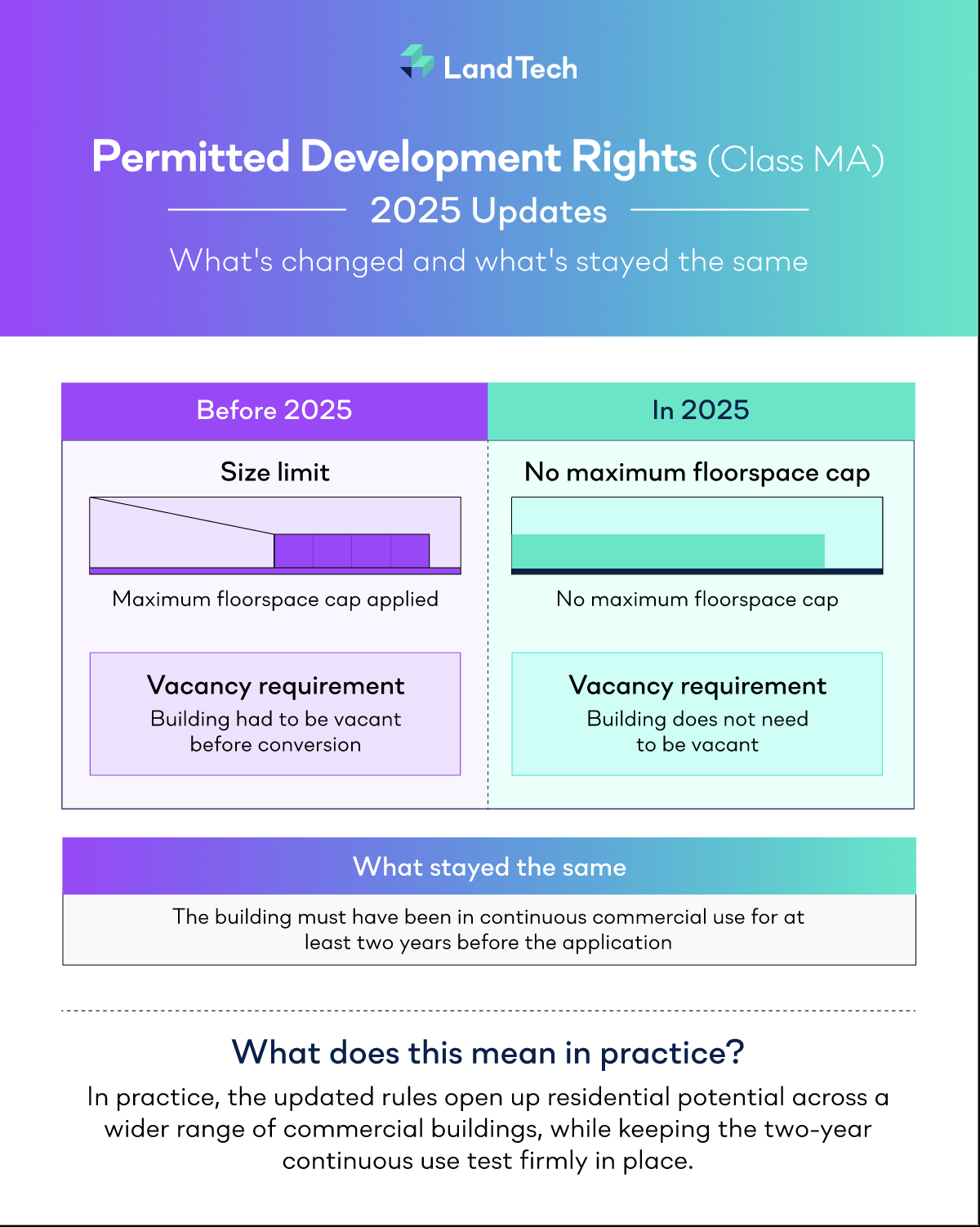
Since 2021, developers have been able to convert many of these buildings into homes via Class MA permitted development rights, which replaced the former ‘Part O’ permitted development right. This shift expanded what’s possible across town centres, and 2025 updates went further to remove the 1500m2 cap and scrap the vacancy requirement.
For most developers, this isn’t new information, but the lasting impact of these policy decisions is worth revisiting. Class E to resi conversion has moved from a narrow opportunity to a scalable, high-street-shaping route for delivering homes.
This article recaps what the latest policy means in practice, how uptake has changed since the 2021 introduction of Class MA, and where the biggest opportunities now lie. We’ll also walk you through how to identify viable Class E sites using LandInsight so you can move quickly and confidently in a market where securing opportunities is increasingly competitive.
Key insights
- Class E covers most everyday high-street commercial buildings (shops, cafés, clinics, gyms, offices and more).
- Class MA allows Class E to C3 residential conversion through prior approval rather than full planning.
- Prior approval is narrower and faster, with councils limited to set tests (e.g. transport, flood risk, noise, contamination, natural light).
- 2025 reforms widened the funnel by removing the 1500 m² cap and 3-month vacancy requirement, while keeping the 2-year commercial use rule.
- LandInsight helps you find and qualify Class E to resi conversion candidates faster by layering constraints, ownership, planning history, comparables, and early viability checks in one place.
Which Building Are Considered Class E?
Class E is the broad commercial use class that captures the majority of high-street, service, and community-facing buildings. Introduced in 2020 as part of a massive consolidation of use classes, it combines what used to be A1–A3, B1, parts of D1 and D2, and more.
Class E includes:
- Retail (shops, post offices, travel agencies)
- Food and drink (restaurants, cafés)
- Professional and financial services (estate agents, banks)
- Office space
- Health and medical services (clinics, health centres)
- Gyms and indoor recreation
- Nurseries and day-care centres
This consolidation allows modern high streets to evolve without requiring a planning application because moving between uses that are all now within Class E is no longer ‘development’.
-
- More predictable: Fewer discretionary policies to interpret
- Bound by statutory time limits: Typically 56 days, after which permission may be deemed granted
- Narrower in scope: Local authorities cannot refuse based on design, townscape, or loss of commercial floorspace unless explicitly allowed under the criteria
What is Class MA? Converting Class E to
Residential
Class MA is the permitted development right that allows developers to convert Class E commercial buildings into C3 residential use via the simpler ‘prior approval’ process.
It was introduced back in 2021, with the Johnson Conservative Government stating that ‘allowing unused commercial buildings to be changed into homes will encourage more people to live near local high streets and come to the area for work and leisure, helping cement our high streets and town centres in their rightful place at the heart of communities.’
Using Class MA means that, in certain circumstances, developers no longer need to submit a full planning application with design documents, public consultation, and committee approval when converting Class E properties to residential.
Under Class MA’s prior approval route, councils can only assess a fixed list of impacts, such as transport, flooding, noise, contamination, and natural light, rather than carrying out a full evaluation.
Class E to MA conversions also reduce procedural risk. Prior approval decisions are:
The practical outcome for developers: Class MA permitted development rights conversions are still regulated, but they’re materially easier to justify, assess, and deliver than a full planning process.
New to use class conversions? Get the full breakdown of what you can and can’t do with our free guide to permitted development rights. Download the guide.
Class E to Resi Transformations: 2025 Update
The 2021 measures introduced three key constraints around eligible buildings:
- Must have a maximum floorspace of 1500 m2
- Must have been in commercial use for at least two years
- Must have been vacant for a minimum of three months
These conditions were originally put in place to stop developers from exploiting vacancy rules, for example, by engineering short-term vacancies. It was also meant to ensure active high-street businesses weren’t displaced.
However, these ended up inhibiting genuinely viable opportunities for conversion.
The two-year commercial use requirement remains, but the 2025 update removed both the size limit and vacancy requirement. This opened up significantly more Class E to resi conversion opportunities.
Local authorities still retain the ability to refuse prior approval based on:
- Lack of natural light
- Noise impact
- Contamination
- Flooding
- Loss of essential community services
- Transport and access considerations
And although Class MA applies in conservation areas, it still excludes other protected land such as National Parks and AONBs.
What Does This Mean for Developers? Key Permitted Development Opportunities for Class E Conversion
While Class MA isn’t a silver bullet for the housing crisis, the data now shows it’s an increasingly meaningful contributor to supply. Projects have become much more viable as the rules have continued to relax.
The ‘commercial, business and service to residential’ category, which corresponds to Class E to resi, only begins appearing as a discrete line item in the national housing supply statistics from 2022–23 onwards.
But even in just three recorded years, the trend is unmistakable:
- 2022–23: 454 dwellings delivered
- 2023–24: 803 dwellings delivered
- 2024–25: 1,048 dwellings delivered
That’s a 131% increase in three years, making Class E to MA one of the fastest-expanding permitted development routes in the current system.
To put that into context:
- The total permitted development (PD) change-of-use supply across all routes fell from 10,340 dwellings in 2021–22 to 7,681 in 2024–25.
- Over the same period, Class E → resi grew from 0 (not yet separately tracked) to 1,048, accounting for roughly 14% of all PD change-of-use completions.
Compared to the early-2020s boom years of office-to-resi, where delivery peaked at 17,751 dwellings in 2016–17, Class E conversion rates are still relatively small. But, they’re rising in a way office-to-resi no longer is: office-to-resi completions have fallen steadily since 2020, down to 5,154 dwellings in 2024–25.
While subsequent changes to the NPPF, including the introduction of Grey Belt in 2025, and the much more substantial changes to the NPPF released in December 2025, may be pulling focus at the moment, Class MA is still a significant opportunity for introducing new residential development in urban areas.
New to PDR? Read our free guide to find out what they are and what the future of permitted development could look like. Download the guide.
How to Identify Strategic Permitted Development Opportunities
Class E to resi conversions offer a faster path to development. But finding the right buildings still depends on having the full picture: from ownership and constraints to comparables and viability.
LandInsight brings all of this together in one workflow to take you from ‘possible opportunity’ to ‘qualified opportunity’ quickly and confidently. Here’s how.
1. Start with a high-level search of commercial buildings
Use LandInsight’s map and filters to surface properties that fall within Class E and have characteristics typically suited to conversion. This could be larger footprints, edge-of-centre positions, or signs of structural vacancy.
You can filter by use class, building type, and size, then layer in planning constraints (e.g., Conservation Areas, Article 4 Directions). This lets you identify potential Class MA candidates in minutes rather than combing through local authority records manually.
2. Open the site's Property Record for deeper context
Click into any building to reveal its full Ownership and Property data. LandInsight shows:
- Current Use Class (including mixed-use)
- Property type, footprint, and floor area
- Title boundaries and ownership information
- Existing planning history
- Indicators of vacancy or change of use
This instantly tells you whether the building is eligible for Class E to resi conversion and whether there are any red flags that could complicate prior approval.
3. Check planning context and constraints
Add layers such as:
- Conservation Areas
- Flood zones
- Article 4 Directions
- Listed buildings
- Public transport access levels
Because these load directly on the map, you can quickly spot which buildings have a straightforward permitted development pathway.
4. Assess local demand and value signals
LandInsight’s market insight tools help you evaluate whether an area supports strong residential demand. You can overlay:
- Sales comparables
- Rental values
- Local housing density
- Pipeline development activity
This gives a clear sense of whether a Class MA conversion would be well-positioned in the local market, as well as whether the site is likely to perform once delivered.
5. Text financial viability before progressing
Once a property looks promising, the next step is to understand whether the numbers make sense. LandInsight consolidates viability assessments into your workflow so you can evaluate financial performance early, using real-world data.
Comparables enable you to benchmark:
- Recent sold prices
- Current market values
- £/sqft rates across unit types
- Hometrack and HM Land Registry data for accurate local pricing
This helps you form an evidence-based view of the site’s end values.
Then, use the LandFund Appraisal Tool to:
- Pull in site attributes automatically
- Model GDV, build costs, finance, fees, and profit
- Test different unit mixes or scenarios
- Get clear viability picture before engaging consultants
This combined interface lets you filter out marginal sites quickly and focus on permitted development opportunities with high potential.
6. Create a shortlist and take action
With ownership, planning, comparables and viability in place, you can now shortlist the strongest prospects. LandInsight enables you to:
- Save sites to projects
- Add notes or documents
- Export reports for internal review
- Begin early outreach to owners directly from the platform
By this point, you’re no longer dealing with speculative leads; you only have well-qualified, high-potential Class MA opportunities.
Get Ahead of Class E Conversion with LandTech
Class E to resi represents a powerful way to support the creation of much-needed homes. Successful developers can cut through complexity of finding viable properties and spot these opportunities early with LandTech.
With LandInsight, you can search planning applications using targeted keywords, review planning history, and access ownership and leasehold data to clarify who controls a site and how easily you can secure it.
Combined with accurate comparables, market insight, and in-platform viability tools, the platform streamlines the entire process of how you identify, assess, and progress Class E conversion opportunities.
As high streets continue to evolve and housing targets remain a priority, the ability to move decisively matters. LandTech gives developers the confidence and clarity to act early and deliver high-quality schemes that work for both communities and the market.
Unlock Class E conversion opportunities before the competition. LandInsight can help you find and assess sites 80% faster to develop a scalable, resilient pipeline.

Frequently Asked Questions About Class E Permitted Development
What are the four main types of planning permission?
In England, the planning system recognises four main types of permissions:
- Full planning permission: For complete, detailed proposals
- Outline planning permission: Establishes the principle of development before detailed designs are submitted
- Reserved matters approval: Deals with the details following outline consent
- Permitted development rights: These allow certain works or changes of use without needing a full planning application, provided conditions and limitations are met
What is the maximum size you can build without planning permission?
There isn’t a single universal ‘maximum size’ that covers all permitted development rights; each carries its own limits and conditions.
The 2025 Class MA update, for example, removed the previous 1,500 m2 floorspace cap for commercial (Class E) to residential conversions. So there is no longer a fixed floor space ceiling under Class MA.
These conversions are instead constrained by the prior-approval tests (natural light, noise, flood risk, contamination, etc.) and by local protections (Article 4 directions, conservation areas, AONBs, National Parks, etc.).
What can I build under permitted development?
The role of permitted development rights is to allow a wide range of works without full planning permission. For commercial developers, the most relevant opportunities include converting certain Class E buildings to residential under Class MA. Note that the permitted ‘development’ under Class MA is the ‘change of use’. If physical works are required to make the building suitable for residential use (e.g. additional windows etc.) then planning permission may still be required.
Is a hair salon Class E?
Yes, hair salons fall under Use Class E(c), which covers commercial services including hairdressing, beauty services, and similar high-street uses. This classification is part of what makes many salons potentially eligible for conversion to residential under Class MA, subject to prior approval.