

Between tight housing targets, limited available land, and strict planning rules, developers often struggle to source parcels that are both viable and low-risk.
In 2024, the Labour Party set a target to build 1.5 million homes over the next five years, which equates to about 300,000 houses annually.* This puts even more pressure on developers to find the right opportunities without too much delay.
Grey belt areas present an interesting opportunity for developers. Located within the Green Belt, these areas should be released from the Green Belt and promoted for development because they only contribute weakly to Green Belt purposes.
In this guide, you’ll learn what grey belt land is, its key characteristics, and its implications for development projects.
We’ll also explain how to identify these sites and how certain tools can give you a competitive edge in finding, assessing, and securing grey belt opportunities.
Key Highlights
- Grey belt land is still Green Belt land. The NPPF 2026 defines it as previously developed land and/or other land in the Green Belt that doesn't strongly contribute to purposes (a), (b), or (d) in policy GB2.
- The rules have moved. The five Green Belt purposes now sit in policy GB2, the assessment method in Annex E, the development tests in GB7, and the Golden Rules in GB8.
- Development on grey belt isn't automatic. Under GB7(1)(g), it must not fundamentally undermine the remaining Green Belt, must meet an evidenced unmet need, and must be in a sustainable location.
- "Unmet need" is now clearly defined. For housing, the council must lack a five year housing land supply, or have scored below 75% in the Housing Delivery Test.
- Major housing schemes must meet the Golden Rules: enhanced affordable housing (usually 15 percentage points above the local requirement, capped at 50%), necessary infrastructure, and accessible green space.
- There's no official grey belt map. Councils identify it through Green Belt assessments and planning decisions, so early, data-led screening gives you a head start.
Understanding the Grey Belt
You need to understand the grey belt if you want to stay ahead in today’s planning game. With councils balancing housing targets and green space protection, knowing what actually qualifies as grey belt land really can help you spot opportunities before everyone else does.
What is Grey Belt Land?
Grey belt land is a relatively new planning concept designed to unlock development opportunities within the Green Belt without compromising its protective purposes.
The NPPF 2026 glossary (Annex B) defines it as "land in the Green Belt comprising previously developed land and/or any other land that, in either case, does not strongly contribute to any of purposes (a), (b), or (d) in policy GB2."
So there are two ways in: land that's previously developed, or any other Green Belt land that doesn't strongly contribute to those three purposes.
Harry Quartermain MRTPI, Head of Research & Insights at LandTech, points out that ''not all Green Belt land is actually green.'
Some Green Belt areas include sites like car parks, sewage works, and quarries, 'which are issued the same level of protection as the agricultural fields around towns that are protected from housing development'.
So while grey belt land technically sits within the Green Belt, it doesn't strongly contribute to the purposes that matter for grey belt, such as preventing urban sprawl, stopping neighbouring towns from merging, or preserving the character of historic towns.
Examples of grey belt sites include disused airfields and low-quality agricultural land. These are usually parcels that don't strongly contribute to core Green Belt functions, meaning they can accommodate development without causing much damage.
Under the National Planning Policy Framework (NPPF), the five Green Belt purposes are set out in policy GB2, and the method for assessing grey belt sits in Annex E (Green Belt assessments). Grey belt assessment focuses on three of those purposes:
- (a) checking the unrestricted sprawl of large built-up areas
- (b) preventing neighbouring towns from merging
- (d) preserving the setting and special character of historic towns
Grey belt sites also need to meet several additional criteria before development counts as "not inappropriate" under policy GB7(1)(g):
- There must be an evidenced unmet need for the development. For housing, footnote 41 sets the test: the council can't show a five year supply of deliverable housing sites (including any buffer), or its Housing Delivery Test result was below 75% over the previous three years.
- The site must be in a sustainable location, "with particular reference to policy TR3". TR3 expects development that generates significant movement to limit the need to travel, particularly by car, and to offer a real choice of transport modes. The government's Connectivity Tool is used alongside other evidence to judge this.
- For major housing, applicants must meet the 'Golden Rules' in policy GB8, which include delivering extra affordable housing, improving local or national infrastructure, and providing or improving publicly accessible green space.
Pro tip: Finding grey belt sites early means you can focus on areas with the best potential rather than spending your time on locations that will face planning resistance. With well-chosen sites, you are less likely to need to prove very special circumstances to justify why development should be allowed.
Grey belt land plays a strategic role in UK planning, and it's a practical tool for making smart, policy-aligned decisions. It can help developers:
- Work towards meeting housing targets: Grey belt sites help local authorities and developers tackle housing shortages in the UK. By focusing on these parcels, you can deliver new homes in currently underutilised areas.
- Distinguish from brownfield land: Unlike brownfield sites, which are previously developed land wherever they sit, grey belt can also include Green Belt land that has never been built on, as long as it doesn't strongly serve purposes (a), (b), or (d). This opens up a wider range of opportunities for developers.
- Strategically release low-value Green Belt sites: Grey belt sites encompass land that's less critical to protecting the Green Belt. This enables developers to unlock development potential while preserving the countryside.
Pro tip: A tool like LandInsight helps you quickly find grey belt land that fits these criteria to give you a head start in early-stage assessments.
Grey Belt vs Green Belt: What's the Difference?
The short answer is that Green Belt is the designation, and grey belt is a subset of it. Grey belt land never leaves the Green Belt just by being grey belt. What changes is the test a proposal has to pass.
What Is Green Belt Land?
Green Belt land is designated in a local plan to prevent urban sprawl by keeping land permanently open. National policy cares most about two things: its openness and its permanence. Policy GB2 gives it five purposes: checking sprawl, preventing towns merging, safeguarding the countryside, preserving historic towns, and encouraging urban regeneration.
Development in the Green Belt is inappropriate unless it falls within one of the categories in policy GB7. Anything else needs very special circumstances, which means the harm to the Green Belt has to be clearly outweighed by other considerations. That's a very high bar.
Where Grey Belt Fits In
Grey belt is the part of the Green Belt that's previously developed, or that doesn't strongly contribute to purposes (a), (b), or (d). Under GB7(1)(g), development on it can be "not inappropriate", so it doesn't need to prove very special circumstances, provided the other tests are met.
|
Green Belt |
Grey belt |
|
|---|---|---|
|
What it is |
A planning designation in the local plan |
A subset of Green Belt, defined in the NPPF glossary |
|
Purposes assessed |
All five (GB2) |
Only (a), (b), and (d) |
|
Default position for development |
Inappropriate unless a GB7 category applies |
Can be "not inappropriate" under GB7(1)(g) |
|
Shown on a map? |
Yes, on the council's policies map |
No official map; identified through Green Belt assessments and decisions |
|
Extra tests |
Very special circumstances, unless a GB7 route applies |
Remaining Green Belt, unmet need, sustainable location, and Golden Rules for major housing |
For the wider picture on building in the Green Belt, including infilling, previously developed land, and very special circumstances, see our guide to getting planning permission in the Green Belt.
What Are the Characteristics of Grey Belt Land?
The hidden value of the grey belt lies in spotting sites that are overlooked but still offer strong development potential.
Understanding the key characteristics of these sites can help you quickly evaluate which parcels are worth investing in to save you time and give you a strategic edge in a competitive market.
It Makes a Weak Contribution to Green Belt Purposes
The defining characteristic of grey belt land is that it doesn't strongly contribute to Green Belt purposes (a), (b), or (d). In other words, its presence doesn't do much to:
- check the sprawl of large built-up areas
- prevent neighbouring towns merging
- preserve the setting and special character of historic towns
For example, a small parcel of land that's nestled between two suburban areas, but is outside of any defined settlement boundary, might not play a meaningful role in preventing sprawl.
Similarly, land that sits away from historic town centres or listed buildings contributes little to preserving character and heritage.
On the other hand, parcels that are central to a town's identity or form a buffer between neighbouring towns wouldn't fall into the grey belt category.
It's Well-Located and Sustainable
Sustainability and location are central to the value of grey belt sites. A site might make only a weak contribution to Green Belt purposes, but if it's poorly connected, bakes in further car dependency, or sits on prime farmland, it won't be a good development opportunity.
To meet the 'sustainable location' test in GB7(1)(g)(iii), a site is judged with particular reference to policy TR3. In practice, that means it should limit the need to travel by car and be easily reachable by public transport, walking, or cycling.
For instance, a site that's just a short walk from a train station with nearby schools, shops, and community amenities is far more attractive for a housing development than a remote plot with limited access.
How Do You Identify Grey Belt Land?
To identify grey belt sites, you first have to understand the five Green Belt purposes set out in policy GB2 of the NPPF. These are to:
- check the unrestricted sprawl of large, built-up areas
- prevent neighbouring towns from merging into one another
- assist in safeguarding the countryside from encroachment
- preserve the setting and special character of historic towns
- assist in urban regeneration by encouraging the recycling of derelict and other urban land
As we mentioned above, only purposes (a), (b), and (d) are specifically called out within the grey belt definition. However, grey belt development is also required to show that it would not fundamentally undermine the purposes (taken together) of the remaining Green Belt across the plan area.
Some Inspectors have used this provision to make reference to other Green Belt purposes not specifically called up in this policy.
That means if a site doesn't strongly help stop sprawl, prevent town merging, or protect historic town character, it could fall into the grey belt category, as long as it also meets other key criteria like sustainability and an evidenced unmet need.
What Annex E Looks For
Annex E gives councils a national method for Green Belt assessments, with illustrative features for a strong, moderate, or weak contribution to each purpose. It's written for plan-making, but it's also the clearest guide to how a site will be judged. In summary:
|
Purpose |
Likely strong contribution |
Likely weak or no contribution |
|---|---|---|
|
(a) Sprawl |
Free of development, no nearby features to contain it, next to a large built-up area, and would create an incongruous "finger" of development |
Not near a large built-up area, or largely enclosed by significant existing development |
|
(b) Merging |
Free of development, a substantial part of a gap between towns, and would lose their visual separation |
Not part of a gap between towns, or only a very small part with no role in visual separation |
|
(d) Historic towns |
Free of development, part of a historic town's setting, and a considerable contribution to its special character |
Not part of a historic town's setting, or no visual, physical, or experiential link to it |
Two details are easy to miss. Purposes (a), (b), and (d) relate to large built-up areas and towns, not villages. And where a plan area has no historic towns, purpose (d) may not need a detailed assessment.
.png?width=780&height=439&name=Figure%201.%20When%20land%20can%20be%20identified%20as%20grey%20belt%20(NPPF%202026%2c%20Annex%20B).png)
Practical Checks Before You Commit to a Site
Policy tells you what grey belt is. These checks tell you whether a particular site is worth your time:
- Start with land that's already been used. Previously developed land is grey belt by definition, as long as it doesn't strongly contribute to purposes (a), (b), or (d). Think depots, yards, car parks, and small commercial premises. Note that the NPPF's definition of previously developed land excludes agricultural and forestry buildings.
- Check constraints upfront. Heritage, flood risk, and habitat designations no longer decide whether land counts as grey belt, but they can still sink a scheme when the proposal itself is assessed.
- Dig into planning history. Repeated refusals don't make a site a write-off, but you'll want to know why they happened before you build your case.
- Understand ownership. Single or multiple owners, ransom strips, and access can turn a quick win into a long negotiation.
- Read the local signals. Look at the council's five year housing land supply and Housing Delivery Test result, since they decide the unmet need test. Local plan reviews and Green Belt assessments are worth watching too.
Identifying grey belt land is about bringing together policy know-how with practical, data-led insights.
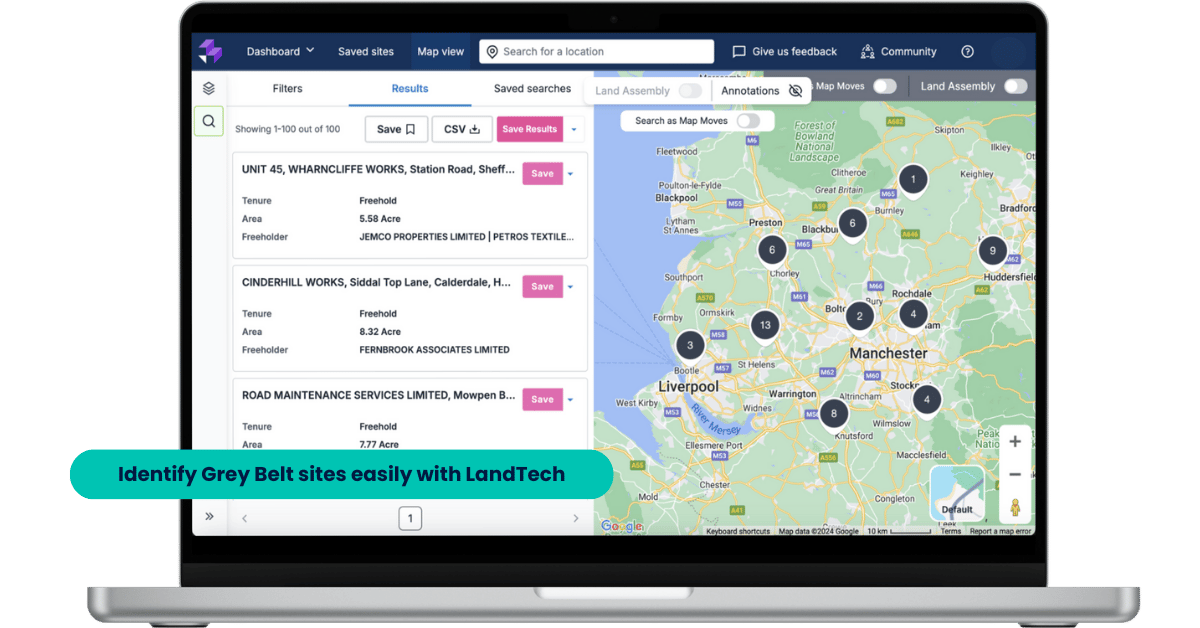
That's where LandTech comes into play. Our platform, LandInsight, lets developers layer data to assess sites against these Green Belt purposes.
- You can map settlement boundaries, physical barriers, and buffers between towns to see if the site scores low for purposes (a) and (b).
- Heritage and conservation datasets help you check purpose (d).
- Add in transport and land use data, and you can get a quick sense of whether a parcel might be suitable for development, all without leaving your desk.
Of course, no tool replaces human judgement. Questions like meeting the NPPF's Golden Rules or checking site viability still need expert eyes. But LandTech gives you a head start by:
- highlighting sites that are less likely to be considered inappropriate
- helping you to focus on parcels with real potential
That means you can move faster when it comes to finding the right sites and concentrate on land that could make an impact on your development pipeline.
Ready to start searching? See how LandInsight helps you find grey belt land and filter it by favourability.

Why Grey Belt Spaces Present An Interesting Opportunity for Land Developers
Spotting grey belt parcels early can give you a serious advantage in a competitive space. Multiple grey belt sites across a borough can add up to a huge impact, both in terms of your portfolio growth and potential ROI.
Instead of chasing the same high-demand urban or brownfield sites that every other developer is fighting over, grey belt land gives you access to areas few others are looking at.
It’s also a chance to think and plan strategically. By understanding where grey belt land sits in relation to settlements, transport links, and local amenities, you can create a pipeline of opportunities that is both sustainable and high-value.
Discover the untapped potential of grey belt land. This guide explores fresh, practical insights for policymakers and developers seeking to build the right homes in the right places.

Can You Build on Grey Belt Land?
Yes, but only when the proposal passes every test in policy GB7(1)(g). If it does, the development is "not inappropriate" in the Green Belt, so it doesn't need to show very special circumstances.
The Four Tests in GB7(1)(g)
Development on grey belt is not inappropriate where all of the following apply:
- It uses grey belt land and would not fundamentally undermine the purposes (taken together) of the remaining Green Belt across the plan area. (GB7(1)(g)(i))
- There's an evidenced unmet need for the type of development proposed. For housing, footnote 41 means no five year housing land supply (including any buffer), or a Housing Delivery Test result below 75% over the previous three years. (GB7(1)(g)(ii))
- It's in a sustainable location, with particular reference to policy TR3. (GB7(1)(g)(iii))
- Major housing development complies with the Golden Rules in policy GB8. (GB7(1)(g)(iv))
Miss one, and the proposal falls back into inappropriate development, with all the evidence that very special circumstances demands.
The Golden Rules (Policy GB8)
The Golden Rules apply to major development involving housing, whether the land is released through a local plan or comes forward through a planning application. Major development means 10 or more homes, or a site of 0.5 hectares or more. All three contributions are needed:
- Affordable housing. This follows the development plan's own requirement for Green Belt sites. Until that's in place, it's 15 percentage points above the highest existing affordable housing requirement, capped at 50%. Where there's no existing requirement, 50% applies by default.
- Infrastructure. Necessary improvements to local or national infrastructure.
- Green space. New or improved green space that's accessible to the public, within a short walk of new homes, supporting nature recovery and meeting local or national standards.
Decision-makers must give substantial weight to compliance with the Golden Rules. A viability assessment arguing a scheme can't meet them is only allowed in three circumstances: previously developed land burdened by costs the plan's viability evidence didn't account for, strategic sites, or development of a wholly different type from what that evidence assumed. Even then, the scheme should make the maximum possible contribution.
The Golden Rules don't apply to land released through plans adopted before 12 December 2024, to permissions granted before that date, or to traveller sites (footnote 43).
A Separate Route: Land Near Well-Connected Stations
Grey belt isn't the only way through. Policy GB7(1)(h) treats residential or mixed-use development within reasonable walking distance (around 800 metres) of a well-connected station as not inappropriate in the Green Belt. The land doesn't need to be grey belt.
The scheme must be physically well related to the station or its settlement, be a scale the infrastructure can support, and not prejudice longer-term comprehensive development nearby. Major proposals must still meet the Golden Rules. Our guide shows how to find NPPF station connectivity sites in LandInsight.
For more on how grey belt is being applied in practice, see our guide to navigating grey belt guidance.
Why Grey Belt Spaces Present an Interesting Opportunity for Land Developers
Spotting grey belt parcels early can give you a serious advantage in a competitive space. Multiple grey belt sites across a borough can add up to a huge impact, both in terms of your portfolio growth and potential ROI. Our early analysis suggested land that might qualify could deliver around 300,000 homes, though that was before the definition was finalised.
Instead of chasing the same high-demand urban or brownfield sites that every other developer is fighting over, grey belt land gives you access to areas few others are looking at.
It's also a chance to think and plan strategically. By understanding where grey belt land sits in relation to settlements, transport links, and local amenities, you can create a pipeline of opportunities that is both sustainable and high-value.
Discover the untapped potential of grey belt land. This guide explores fresh, practical insights for policymakers and developers seeking to build the right homes in the right places.
Find Grey Belt Land and Gain a Competitive Edge with LandTech
As you now know, grey belt land presents an untapped opportunity, but finding the right sites can be tricky without the proper tools.
LandTech combines planning data, ownership records, transport and heritage information, and agricultural classifications to help you quickly identify parcels that are the most likely to qualify as grey belt, and give you a head start over other developers.
Early-stage evaluations against Green Belt purposes (a), (b), and (d), along with sustainability indicators and local need data, let you prioritise the parcels with the highest likelihood of successful development.
And by centralising all this information, LandInsight makes decision-making far simpler, which reduces the risk of missed opportunities.
LandTech helps you move faster and build a strong pipeline of grey belt opportunities. You get the insights you need to identify, assess, and secure sites that deliver impact, all while navigating the complexities of Green Belt policy with ease.
Find, assess, and secure grey belt sites faster than anyone else. Discover how LandTech can give you a competitive edge in sourcing promising sites with in-depth data and automated alerts.

*Planning overhaul to reach 1.5 million new homes, GOV.UK
FAQs About Grey Belt Land
Is There a Grey Belt Map?
No, there's no official national grey belt map. Grey belt is identified by councils through Green Belt assessments under Annex E, and through individual planning decisions. LandInsight's Grey Belt and Declassified Green Belt layer lets you find grey belt land and rank it by favourability as a starting point.
Can You Build on Grey Belt Land?
Yes, if the proposal passes every test in policy GB7(1)(g): it uses grey belt land without fundamentally undermining the remaining Green Belt, meets an evidenced unmet need, sits in a sustainable location, and, for major housing, meets the Golden Rules in GB8.
Did the NPPF 2026 Change Grey Belt?
It kept grey belt, but reorganised the rules. The definition is in the Annex B glossary, the five purposes are in policy GB2, the development tests are in GB7, the Golden Rules are in GB8, and the assessment method is in Annex E.
What Is the Grey Belt in Politics?
In UK politics, grey belt describes Green Belt land that could take new homes without undermining the core purposes of the remaining Green Belt. It's often used for sites like old car parks, yards, and empty plots.