
Finding opportunities before competitors snatch them up is a constant struggle in the development world. Strategic land presents a potential solution to this problem.
Strategic land refers to parcels that aren’t yet allocated for development, but have the potential to secure planning permission and unlock huge value.
In this guide, we’ll explain what qualifies as strategic land, who should consider taking on these deals, and the steps to identify and successfully bring sites forward.
What is Strategic Land, and How Do These Deals Work?
Strategic land is land that isn’t allocated for development yet, but realistically could be in the future. It usually sits just outside a town or city boundary, has no planning permission in place, and hasn’t been earmarked for immediate growth.
In short, it’s land that can be taken from brownfield or greenfield status and turned into residential properties. And with the right evidence and a strong planning case, strategic land sites have the potential to become new homes or even entirely new settlements.
Consider, for example, agricultural fields on the edge of a market town, or underused greenfield parcels next to a primary school, a bypass, or existing utilities.
The financial uplift remains substantial. In 2026, greenfield sites like prime agricultural land typically sells for £9,000 to £11,500 per acre. However, once a site secures full residential planning permission, values in high-demand growth corridors can reach £1.5 million to £2.5 million per acre, depending on density and local infrastructure requirements.
That’s why many people who specialise in strategic land aren’t property developers or housebuilders themselves. Instead, they’re land promoters. They find viable sites, secure planning permission (and that uplift in value), then sell to a developer to handle the actual build.
Here’s how a typical strategic land deal works:
- Identify a promising site: Often on the edge of a growing town, especially where the local plan is due for review.
- Secure control of the land: Usually through options agreements rather than outright purchase.
- Lead the planning work: Technical studies, assessments, and submissions that unlock value.
- Sell or exercise the option once permission is granted: Housebuilders take over the construction, while promoters move on to the next opportunity.
This model frees up promoters to grow a pipeline of strategic land projects, turning today’s empty fields into tomorrow’s new projects and communities.
References & Data Sources:
Agricultural Values: Knight Frank English Farmland Index (Q4 2025/Q1 2026).
Arable Benchmarks: Strutt & Parker English Estates & Farmland Market Review (Winter 2025/26).
Development Land Values: Savills Residential Development Land Index (Q4 2025).
Market Analysis: Landlister UK Land Market Overview (2026).
Recent Changes to Strategic Planning and What They Mean for Developers
The government’s recently proposed Planning and Infrastructure Bill aims to introduce a system of strategic planning across England: Spatial Development Strategy (SDS).
‘The rollout of the strategic planning system will help deliver sustainable growth and address key spatial issues such as meeting housing needs, delivering strategic infrastructure, growing the economy, and improving climate resilience and nature recovery,’ states the government’s strategic planning factsheet.
What does this mean in practice? SDSs will help to identify strategic development locations and the likely scale of growth, making it easier to locate and target these opportunities.
Who Should Consider Strategic Land Deals
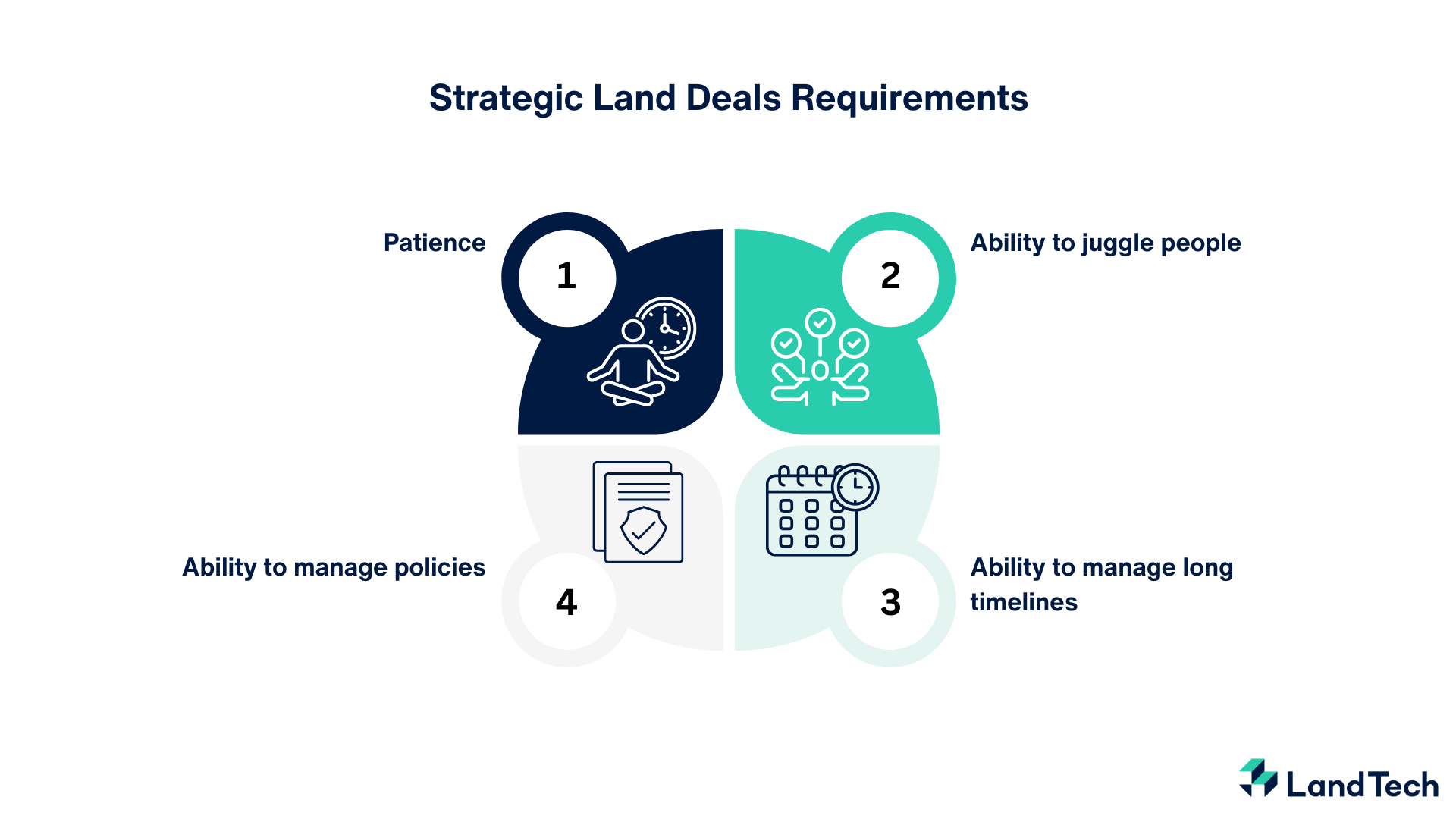
Strategic land deals aren’t right for everyone. They require patience and the ability to juggle people, policies, and potentially long timelines.
However, for the right profile, the rewards can be significant. Successfully securing strategic land can create new communities, unlock huge uplift, and give promoters the freedom to focus on their next projects – not to mention the satisfaction of shaping new settlements and contributing meaningfully to the local area.
If you fit into any of the below categories, these types of deals may be worth pursuing.
Patient Planners Who Think Long-Term
Strategic land isn’t always a quick win, and some deals can take years, or even decades, to complete. But if you’re in it for the long haul and can plan moves several steps ahead, strategic land could be a good fit for you.
Successful land promoters track demographic trends and economic growth projections over multi-year timelines, and they’re always looking to future predictions. Being able to anticipate how a town or suburb will expand can give you a massive head start over competitors.
Resource-Rich Developers and Investors
These deals often tie up substantial funds, even if you’re not buying the land outright. You’ll need capital for planning fees, technical studies, and staff time. In addition, you need to be comfortable with the uncertainty that comes with navigating the strategic land planning process.
If you have the financial means to sustain long-term development and absorb delays and setbacks, you can engage with strategic land effectively.
Planning-Savvy Professionals
If you want to secure strategic land, you need to understand how local authorities operate and what planning is permitted. Experienced promoters know how to read subtle signals from planners and adjust their strategies accordingly, which reduces the risk of backing a site that will never get approved.
They follow council committee minutes, track consultations with residents, and note where previous applications failed, often spotting opportunities that others ignore. And sometimes the path to approval changes during the process due to policy shifts or local objections. Developers who can pivot quickly and adjust proposals have a real advantage.
People With Vast Networks
A successful strategic land deal involves far more than the landowner and the promoter. You’ll need to engage with:
- Local residents: Early conversations can help shape proposals and reduce objections.
- Politicians and local authority offices: Understanding priorities and policy direction is key.
- Agents and other promoters: They can advise or even collaborate on new projects.
Effective promoters treat these relationships with care and proactively network and nurture connections. This makes engagement a central part of strategic land deals, not just a reaction to objections.
A Data-Driven Approach to Securing Strategic Land Opportunities: 4 Proven Steps
You can’t rely on connections and experience alone to find strategic land. The real edge comes from combining local planning knowledge with technology that makes early-stage evaluation fast and evidence-based.
Platforms like LandInsight and LandFund enable this kind of data-driven approach and can help promoters and developers make smarter decisions and build a pipeline of high-potential strategic land projects. Below are some steps to follow to get this right.
1. Find Appropriate Sites
The first and arguably most important element to strategic land deals is knowing where to look. Not every parcel of land outside a settlement boundary has development potential, and even fewer are worth the time to pursue.
That’s where a data-driven land acquisition platform can help. With LandInsight, for example, you can pinpoint strategic land sites that:
- Sit just outside normal settlement boundaries
- Don’t currently have planning approval
- Have a realistic chance of gaining planning in the future
By overlaying your search areas with LandInsight’s constraint data, you can filter out sites that are heavily restricted while focusing on plots that are unconstrained but adjacent to planned growth areas or significant unmet demand.
This combined intel helps you find opportunities where the probability of planning success is the highest. For example, a previously overlooked greenfield parcel near a new transport corridor or within a designated growth area can jump to the top of your list.
Key takeaway: When you combine analysis, local planning intelligence, and constraint filters, you can spot hidden opportunities, including land that others might overlook but that has genuine potential for uplift development.
2. Secure the Land For Development
Once you’ve identified a promising site, the next step is to figure out how to actually acquire it. You don’t necessarily need to buy strategic land outright, and there are often smarter ways to secure a site while managing risk and preserving capital. Here are the main approaches.
- Buying land outright ties up significant funds and exposes you to the full risk if planning permission doesn’t come through. This approach is only ideal if you have the capital and the site is relatively low risk.
- Option agreements give you the right to purchase the land at a later date once certain conditions are met (often securing planning permission). This approach reduces upfront cost and risk while locking in potential control over the site.
- Promotion agreements don’t require that you purchase the land at all. Instead, you agree with the landowner to guide the site through the planning system. Once planning permission is granted (and the land’s value increases), you can either sell to a developer or take a share of the uplift.
The approach you choose for securing depends on your risk tolerance, resources, and timeline.
Promotion agreements often suit those focused on multiple strategic land projects, as this allows them to move from one opportunity to the next without locking up capital unnecessarily. Outright purchases might make sense for smaller, lower-risk plots where you want full control of the outcome.
Key takeaway: Understanding your options and picking the right approach lets you find land efficiently while minimising exposure. This keeps your pipeline full and your projects moving forward.
3. Approach Planning Strategically
Once you control a site, the next challenge is navigating the planning application process. How you approach this can make or break a deal, and it’s where experience and insight really come into play.
There are two routes you can take here: collaborative or combative.
With a collaborative approach, you engage early with local authorities, residents, and other stakeholders to discuss proposals and demonstrate how your project aligns with local plans and wider community goals.
This can be time-consuming, but it often reduces objections down the line and speeds up approval. For instance, communicating that you plan to build new homes alongside community facilities or green spaces can turn a hesitant council into an advocate for your project.
A combative approach means taking a hardline strategy. You need to push proposals aggressively with the expectation that local authorities will eventually approve, especially in areas struggling to meet housebuilding targets.
Key takeaway: The key is balancing risk with reward. These deals are inherently long-term, and the gamble of strategic land is real, as a misstep in planning can stall a project for years. Successful promoters discuss ideas, negotiate solutions, and position the site as a net benefit to the community.
4. Decide Whether You'll Build Or Sell
Now that a housing allocation, or outline planning permission is secured, you face a big decision: do you develop the site yourself or sell it to another developer? Both routes have pros and cons, and the right choice depends on your resources and appetite for risk.
When you build yourself, you retain control and capture full uplift, but you also take on the cost, project management, and delivery tasks.
This route can be rewarding, especially if you want to shape how the project is integrated into the community and ensure quality standards are met. However, it ties up significant investment and requires a deep understanding of factors like construction, logistics, and compliance.
That’s why many promoters prefer selling to a developer. You realise the uplift from securing planning without the operational burden of delivering the project.
The eventual sale frees up capital and time to promote other opportunities, which keeps your strategic pipeline moving. The trade-off is that you forgo some control over the finished development, but the reduced risk can be well worth it.
Some promoters take a hybrid approach by retaining a small stake in the project while selling the majority. This balances potential upside with risk mitigation.
Key takeaway: Whatever you decide to do, the key is making a choice that’s aligned with your capabilities, available resources, experience, and long-term goals.
Why LandInsight is the Smart Choice for Sourcing Strategic Land
When it comes to finding strategic land, having the right tools makes all the difference. LandInsight enables you to instantly view site boundaries and assess planning restrictions so you can spot strategic land efficiently.
And proactive alerts mean you’re the first to know about emerging opportunities or changes in local plans, which gives you an edge in a competitive space.
The platform enables smarter, faster, and more profitable strategic land sourcing, which allows you to focus on building your pipeline of projects with ease.
Secure strategic land before your competitor. LandInsight helps you sort and assess strategic land sites quicker than ever before.