

How to Value Development Land
If you're a developer with a site on your radar, the question isn't really "what is this land worth?" It's "what can I afford to pay and still make the numbers work?" Those are two different questions, and mixing them up is how sites get overpaid for.
This guide covers the three ways developers actually value land: the residual method, comparable evidence, and income-based valuation for investment-led schemes. It walks through a worked example using realistic UK figures, sets out how planning status changes value at each stage, and points to tools you can use to speed the process up.
Jump to whichever section answers your question, or read it start to finish for the full picture.
Key Highlights
- Land value is the maximum a site can support once costs, risk, and required profit are properly accounted for - not a fixed £ per acre figure
- The residual method (GDV minus costs minus profit) is the primary approach for most residential development
- Comparable evidence and Land Registry data show what the market has actually paid, but need adjusting for planning status and timing
- Planning permission is the single biggest driver of value; agricultural land can be worth a fraction of its value once residential consent is granted
- UK greenfield land values fell by 3.3% annually as of Q2 2026, with sharp regional divergence between the North, Scotland, and the South East
- Build cost inflation and financing assumptions materially affect what a site can support, so sensitivity testing matters as much as the base case
- The LandTech Appraisal Tool automates residual valuation, and LandFund helps you finance against the value a site unlocks
What Determines Development Land Value
Before you get into methods and formulas, it helps to understand what's actually moving the number. Five factors do most of the work.
1. Planning Status
This is the biggest lever by far. Agricultural land with no planning history is worth a fraction of the same land with outline or full permission attached. We'll come back to this in detail below, because it's the single most misunderstood part of land valuation.
2. Location and Comparable Sales Evidence
Two sites a few miles apart can have very different values depending on transport links, school catchments, local demand, and what's recently sold nearby. Location doesn't just affect sales values; it affects build costs, infrastructure requirements, and how quickly units will sell once built.
3. Site Constraints
Contamination, poor ground conditions, restricted access, or the need for utility upgrades all add cost, and cost comes straight off the land value. A site that looks attractive on a map can turn out to be marginal once constraints are properly assessed.
4. Development Type and Achievable Density
What you can build - and how much of it - depends on planning policy, site shape, and local design requirements. Net developable area (not gross site size) is what actually drives value, and awkward or inefficient sites lose value even when the headline acreage looks generous.
5. Current Market Conditions
Land values move with the wider property market, and that movement isn't uniform across the country. According to Savills' Q2 2026 Residential Development Land research, UK greenfield land values fell by 1.2% over the quarter and 3.3% over the year, with the South East seeing the steepest quarterly fall at 2.2%, while the North and Scotland were the only regions to record growth, both up 0.3%. Urban land values fell further still, down 6.6% annually, reflecting ongoing viability pressure on brownfield and high-density sites. On top of that, Savills notes BCIS is forecasting build cost inflation to ease from around 3.2% a year to closer to 2.0% by the end of 2026 - still upward pressure on costs, just at a slower rate. The upcoming Future Homes Standard, which applies to all new build homes from 2028 and pushes toward zero-carbon construction, is also a factor developers are starting to build into longer-term appraisals.
None of these factors work in isolation. A well-located site with full planning permission can still be a poor deal if ground conditions are bad enough, and a constrained site can still stack up if the planning position is strong enough to offset it. That's why developers use structured methods rather than rules of thumb.
The Residual Method
Most development land is valued using the residual method. It's the approach that links price directly to deliverability, which is why it tends to govern the final offer even when other methods are used alongside it.
The formula is straightforward:
Gross Development Value (GDV) − Build Costs − Professional Fees − Planning Obligations − Finance Costs − Developer Profit = Residual Land Value
What each element means:
- GDV is what the completed scheme will sell for - every unit, at realistic sale values, added together.
- Build costs cover construction: materials, labour, and site-specific costs like groundworks.
- Professional fees are typically added on top of build costs to cover architects, engineers, quantity surveyors, and project management.
- Planning obligations are Section 106 and CIL contributions, which vary significantly by site and local authority.
- Finance costs reflect the cost of borrowing to fund the build and carry the site through to sale.
- Developer profit is the return required to justify the risk - commonly in the region of 15–20% of GDV for residential schemes, though this varies with risk appetite and funding structure.
Whatever's left after all of that is the ceiling - the maximum a developer can pay for the land and still hit their required return.
A Worked Example
Say you're looking at a 0.6-hectare (roughly 1.5-acre) allocated residential site with outline planning permission for 20 units, a mix of two- and three-bedroom houses averaging around 85 sq m each.
Gross Development Value: 20 units × an average sale value of £300,000 = £6,000,000
Build costs: Using an indicative standard-specification build cost of around £2,100 per sq m (current UK new-build costs typically sit in the £1,800–£3,000 per sq m range depending on specification and location), 20 units × 85 sq m × £2,100 = £3,570,000
Professional fees: 10% of build costs = £357,000
Planning obligations (S106/CIL): Assumed at 5% of GDV for this example = £300,000
Finance costs: Assumed at 4% of GDV for this example = £240,000
Developer profit: 20% of GDV = £1,200,000
Total costs: £3,570,000 + £357,000 + £300,000 + £240,000 + £1,200,000 = £5,667,000
Residual land value: £6,000,000 − £5,667,000 = £333,000
That works out at roughly £222,000 per acre for this scheme - a useful illustration of just how far value moves once planning permission and a deliverable scheme are attached, compared with the raw agricultural value of the same land (more on that below).
Every figure in this example is illustrative, built from typical UK cost and price ranges rather than a real transaction. Build costs, obligations, and finance assumptions are highly site- and location-specific, so always model your own numbers rather than applying these directly to a real site.
Common Pitfalls
The residual method is only as good as the assumptions that go into it. The two mistakes that come up most often:
Over-Optimistic GDV
It's tempting to use the strongest recent comparable rather than a realistic average, particularly in a rising market. If sales values soften before the scheme completes, the margin for land can disappear fast.
Underestimating Build Costs
With build cost inflation still running above 2% a year according to BCIS forecasts, and material and labour costs prone to sudden movement, a static cost assumption can leave a scheme short. Sensitivity testing - running the appraisal with costs 5–10% higher - is standard practice for a reason.
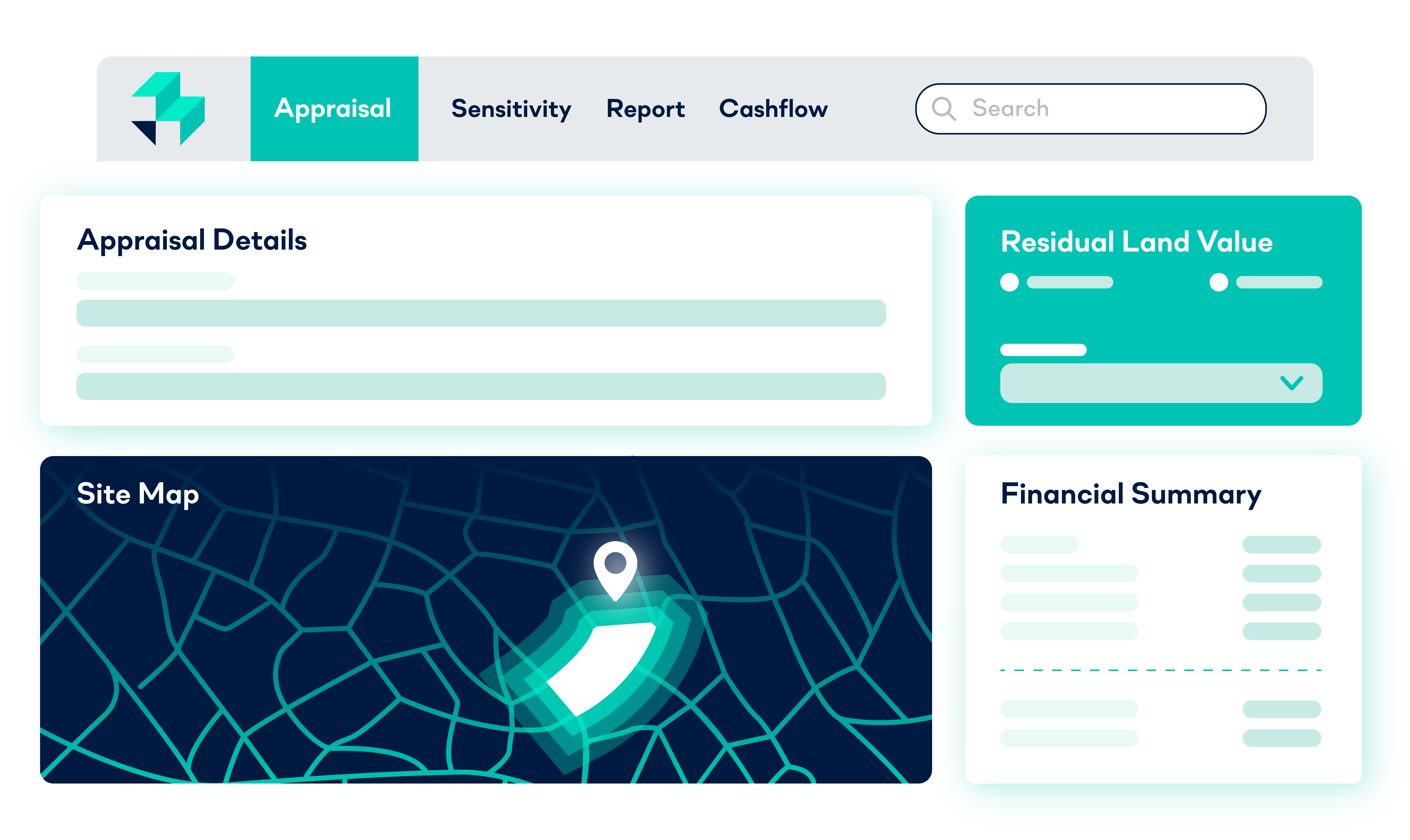
The LandTech Appraisal Tool automates this calculation, letting you model GDV, costs and profit assumptions quickly and stress-test different scenarios without rebuilding a spreadsheet from scratch every time.

Comparable Evidence Method
Comparable evidence tells you what the market has actually paid for similar land, which makes it a useful sense-check against the residual method - even though it shouldn't replace it.
What Comparables Are and Where to Find Them
A comparable is a recent sale of land in a similar location, with a similar planning status, that gives you a benchmark price. Sources include HM Land Registry price paid data, local land agents, and LandTech's own datasets, which bring together transaction and planning history in one place.
Adjusting for Planning Status and Site Differences
No two sites are identical, so comparables need adjusting. A site with full planning permission is not comparable to speculative land, and a transaction agreed eighteen months ago in a stronger market won't automatically translate to today's conditions. Site size, shape, constraints, and local infrastructure requirements all need factoring in too.
Current UK Benchmarks
Land values vary considerably by region and are moving in different directions depending on where you look. Per Savills' Q2 2026 data, greenfield land values are down 3.3% annually across the UK as a whole, but the North and Scotland were the only regions recording quarterly growth (both +0.3%), while the South East saw the sharpest quarterly fall at 2.2%. Urban land is under greater pressure still, down 6.6% annually, reflecting ongoing viability challenges on brownfield sites, particularly where high-rise construction is involved. Savills also flags that diminishing buyer appetite for flats is putting further pressure on city centre land values specifically. These averages disguise significant local variation, which is exactly why comparables need to be read alongside - not instead of - a proper residual appraisal.
Why Comparables and Residual Should Align
If your residual calculation comes out well above or below what similar sites have actually traded for, that's a signal to check your assumptions. Sometimes the gap is justified (a stronger planning position, a better location within the same broad area), but if you can't explain it, something in the appraisal probably needs revisiting.
Land Value at Different Planning Stages
Planning status is, by a wide margin, the biggest single driver of land value. Here's roughly how it plays out at each stage.
Agricultural Land
According to Knight Frank's Farmland Index, the average value of bare agricultural land across England and Wales stood at £8,497 per acre in Q2 2026, down 1.5% over the quarter and 4.1% over the year -though values remain historically high, having risen more than 20% over the past five years. Knight Frank's own analysts note that with so few transactions currently completing, headline averages disguise huge local variation: prime land in areas like the north Cotswolds can still achieve £20,000 an acre, while other areas may struggle to reach £10,000.
Land With Outline Planning Permission
Outline permission establishes the principle of development without settling every detail, and it moves value up sharply because it de-risks the site for a buyer. The exact uplift depends entirely on the scheme's deliverability and viability, but this is the stage where speculative land starts to be priced against a realistic residual calculation rather than agricultural comparables.
Land With Full Planning Permission
Full permission removes most of the remaining planning risk, which is why it commands the highest price per acre of the three. A frequently cited government figure - from Department for Communities and Local Government statistics published in 2015 and referenced in a House of Commons Housing, Communities and Local Government Committee report - put the average uplift for agricultural land granted residential planning permission in England (excluding London) at rising from around £21,000 per hectare to £1.95 million per hectare. That figure is dated and the range around any individual site is extremely wide, but it illustrates the scale of what planning permission can do to a site's value. As one chartered surveyor's guide puts it, this uplift isn't a simple multiplier - it's driven by the residual value of the specific scheme that's been consented, so context matters more than the headline number.
The Planning Uplift - What to Expect and How to Negotiate
Because so much value sits behind the grant of planning permission, negotiations over land often centre on how that uplift is shared between landowner and developer, particularly on option agreements and conditional contracts where a purchase price is only finalised once permission is secured. Understanding where a site sits on this curve - agricultural, allocated, outline, or full permission - is essential before any offer is put on the table.
Because so much of a scheme's value is unlocked at the point permission is secured, financing against that uplift is often the difference between a deal proceeding and stalling. LandFund helps developers raise finance built around the value a site gains once planning is in place.
Tools and Calculators
If you want to move from theory to a number on your own site, you have a few options.
The LandTech Appraisal Tool is the fastest route - it automates the residual calculation, lets you build multiple scenarios, and removes the manual spreadsheet work involved in stress-testing GDV, costs and profit assumptions.
A manual calculation is also entirely workable for a first-pass estimate. Take your best estimate of GDV, subtract build costs, professional fees, planning obligations, finance costs, and required profit, and what's left is your indicative residual land value - exactly as set out in the worked example above. It won't capture every nuance of a real scheme, but it's a reasonable starting point before a full appraisal.
For further reading, LandTech's resource centre and webinars cover related topics including how to strengthen a development appraisal before presenting it to a lender.
Summary
Land value isn't a single number you can look up; it's the outcome of a calculation that changes with planning status, market conditions, build costs and the returns a scheme needs to deliver. The residual method sets the ceiling. Comparable evidence checks it against what the market's actually doing. And for investment-led schemes, income and yield tell a different but related story.
If you've got a site in mind, the fastest way to find out whether it stacks up is to run the numbers properly rather than relying on a rule-of-thumb per-acre figure. Try the LandTech Appraisal Tool to model your own scheme, or book a demo to see how LandTech supports land valuation and acquisition from end to end.
FAQs About How to Value Land
How do you value land for development?
Most development land is valued using the residual method: estimate the completed scheme value, deduct all development costs and required profit, and the remainder is the maximum the land can support. Planning risk, policy requirements, and site constraints materially influence that calculation.
How do you calculate the value of land?
For development sites, land value is typically calculated as GDV minus construction costs, professional fees, planning obligations, finance, contingencies, and developer profit. The result is the residual land value.
How do you determine the price of land?
The price of land is ultimately negotiated. Developers assess what the scheme can viably support and bid accordingly, while landowners base expectations on market evidence and planning potential.
How much is land worth to a developer?
Land is worth the maximum price that still allows the developer to achieve their required return, given planning probability, build costs, funding structure, and exit strategy.
How much does land valuation cost?
Professional land valuations vary depending on site complexity and scope. However, internal developer appraisals are typically undertaken as part of the land acquisition process before submitting an offer.
How can you get a piece of land valued?
You can instruct a qualified surveyor for a formal valuation, or conduct a development appraisal using residual valuation principles. The appropriate route depends on whether the land is being held, financed, or actively marketed.