
We’ve all been there. You’re standing in a damp field in the Home Counties and your gut is telling you, “there’s a project here.” It’s a classic developer trait: optimism. You need it to survive in this industry. But as any seasoned land developer will tell you, optimism is also the quickest way to lose a fortune.
When we sat down with our network of SME developers and planning pros recently, the conversation didn't centre on how to find more sites. It centred on how to stop looking at the wrong ones.
Key Highlights
- The Danger of "Gut Feeling": While optimism is a common developer trait , relying on intuition or "heuristics" can lead to expensive mistakes and the Sunk Cost Fallacy.
- Adopting "Kill Criteria": Successful developers treat site assessment like a clinical trial. If a site cannot pass a "10-minute test" on a laptop, it is disqualified before any time or travel costs are incurred.
- The Shift to Data-Led Decisions: Moving from intuition-led to data-led strategies involves using actual Sold Prices and Hometrack data rather than "asking price" noise to determine a site's true viability.
- Analysing Planning Precedents: Professionals check Planning Application layers in LandInsight to identify previous refusals or "scars" on a site, avoiding projects with inherent density or highways issues.
- Targeting the "Grey Belt": Instead of manually searching through council PDFs, developers are using specialised filters to instantly pinpoint Grey Belt land that meets new, favorable criteria.
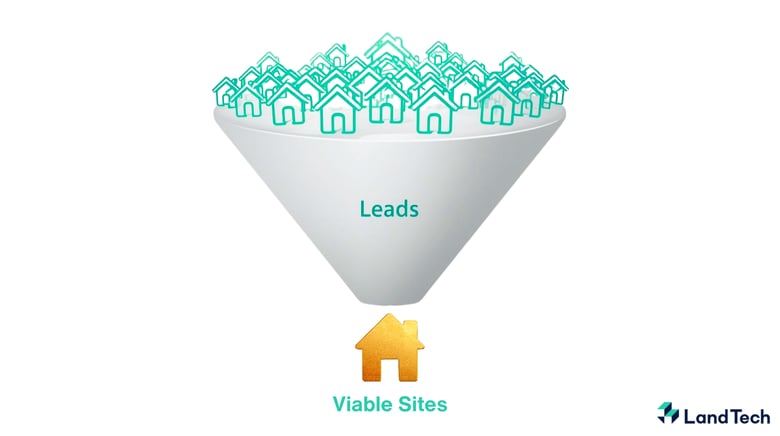
- Efficiency Over Volume: The goal of modern site-finding is to disqualify 90% of leads quickly, allowing 100% of energy to be focused on the 10% of sites that are truly viable.

The "Gut Feeling" - Can (And Should) You Trust It?
In the old days (pre-data ubiquity), site finding was often led by heuristics - those mental shortcuts we call “experience.” You knew the area, you liked the look of the frontage, and you’d figure out the viability later.
The problem? By the time you’ve spent three weeks on a site appraisal, you’ve already fallen in love. This is the Sunk Cost Fallacy in a hi-vis vest. You start tweaking the build costs or nudging the GDV just a little higher to make the numbers justify the time you’ve already "invested."
"The 'gut feeling' approach is an expensive hobby," says one Strategic Land Manager based in the North West. "If I’m looking at a Green Belt site, I don’t care how 'logical' the infill looks. If the data shows the local authority is miles off their housing target but still hasn't updated their Local Plan, I need to know that before I waste a penny on a consultant."
Amateurs look for potential. Professionals look for a reason to bin the deal and move on to the next one.
Enter the "Kill Criteria"
The most successful developers we work with treat site assessment like a clinical trial, not a passion project. They use what we call ‘kill criteria’. These are the non-negotiables that a site must pass before a single mile is clocked on the car. If it doesn't pass the "10-minute test," it’s dead.
"My rule is simple: If I can't prove the exit price in 10 minutes on my laptop, I'm not driving two hours to look at a muddy field. I used to chase everything; now I only chase the sure things." - Anon. Land Director, South East
It sounds ruthless, but it’s actually just efficient. In a market where planning policy shifts like North Sea sand, being "brave" with a site is often just a polite word for "expensive."
Data: The Antidote to Optimism Bias
To be that clinical, you need a "scientific control." You need to know - not guess - what the local market is actually doing.
This is where the shift from Intuition-Led to Data-Led happens. Instead of trying to make a site work, the pros use tools like the LandInsight Comparables Calculator and Sold Prices to act as a reality check.
- The 10-Minute Appraisal: If the actual sold prices of three-beds in a half-mile radius don't support your exit strategy, no amount of "vision" will change the bank’s mind. Use the Comparables Calculator within LandInsight to strip away "asking price" noise. By looking at actual Sold Prices and Hometrack data, you can see if the GDV actually supports the build costs before you even talk to an agent.
- Planning Precedents: Check the Planning Application layers to see the "scars" of the site. If the last three applications were refused on highways or density issues, you aren’t just "finding land" - you’re finding a headache.
- The Grey Belt Filter: Don’t guess which Green Belt sites are now "favourable." Use LandInsight’s Grey Belt Favourability filter to pinpoint land that meets the new criteria instantly, rather than trawling through dusty council PDFs.
- The Efficiency Play: Using data to disqualify 90% of your leads means you can spend 100% of your energy winning the 10% that actually stack up.
The Takeaway: Stop "Making It Work"
The best developers aren't necessarily luckier than you; they’re just more protective of their time. They’ve realised that finding land is easy - anybody can find a field - but finding viable land is the real science.
The goal isn't to be the person who saw the most sites this month. It’s to be the person who only saw the ones worth buying.
Stop trying to make bad sites work. Start using data to find the ones that already do.