
For anyone assessing agricultural land in England, April 2026 brought a quietly significant bit of news. Defra published a new Predictive Agricultural Land Classification (ALC) map - augmenting the old Provisional map that, frankly, was showing its age. We're talking data compiled from surveys carried out between 1967 and 1974, digitised from one-inch-to-the-mile paper maps. It was the cartographic equivalent of navigating by a dog-eared A-Z.
The new map is built on something altogether more rigorous. And if you're sourcing or assessing greenfield sites, it's worth understanding what's changed - and what it means for how you read a constraint layer.
What Is the ALC System, and Why Does It Matter?
The Agricultural Land Classification system grades farmland in England and Wales from Grade 1 (excellent quality) down to Grade 5 (very poor). The grades reflect how much a parcel of land's physical characteristics - soil depth and structure, drainage, climate, slope - limit its potential for agricultural use.
For developers and land professionals, the grades that really matter are 1, 2, and 3a. These are classed as Best and Most Versatile (BMV) land, and they carry the strongest planning protection under the NPPF. Local planning authorities are required to take the economic and other benefits of BMV land seriously when considering development proposals. In practice, that means sites graded 3b or below tend to make for smoother conversations with planners than those sitting in 3a or above.
Grade 3 is where a lot of the action - and a lot of the ambiguity - lives. It's a broad band of "good to moderate" quality land, and the distinction between 3a and 3b can be the difference between a viable site and an uphill battle. The old Provisional map couldn't show that split at all. It predated the subdivision entirely.
What's New About the Predictive ALC Map?
The new Predictive ALC map add to the old Provisional version, remodelled using the best available soils data from LandIS (the Land Information System held by Cranfield University - one of the largest soil datasets in Europe). It applies the standard (MAFF 1988) methodology for grading agricultural land, which crucially includes the Grade 3a/3b subdivision, and runs at a 50-metre grid resolution, using the most limiting factor per grid square to determine grade.
The result is something considerably more reliable for strategic assessment. Defra's own analysis found that around 20% of land has moved up by one grade under the revised model, while less than 20% has moved down. That's not trivial; it means some parcels that looked like BMV land on the old map may now sit in Grade 3b or lower, and vice versa.
It's also worth noting that Defra is currently undertaking a full technical review of the ALC system, due to complete in 2028. The Predictive map is the most accurate tool available right now - but the system itself is still evolving.
The Important Caveat: Strategic Use Only
Here's the bit that's easy to miss, and genuinely important. The Predictive ALC map is a strategic tool. It's produced at a scale suitable for high-level planning and targeting - not for making determinations on individual parcels or fields.
For planning applications that affect agricultural land, you still need a detailed, field-based ALC survey. The map won't replace that. What it will do is help you work out where it's worth commissioning one. If a site is predicted to be Grade 3b or lower, that's useful intelligence early in your assessment process. If it's sitting in BMV territory, you know you need a survey - and probably a good planning consultant alongside it.
Think of it as a triage tool. Not a verdict, but a much better-informed starting point than the map it replaced.
What This Means for Site Assessment
The practical upshot for site finding:
- Grade 3b and below - generally more navigable from a planning perspective. The new map gives you more confidence that a 3b classification is genuinely 3b, not a relic of 1970s survey methodology.
- Grade 3 without subdivision - if you're working with older or site-specific data that doesn't distinguish 3a from 3b, a field survey is still the only way to know for certain where you stand.
- BMV land (Grades 1, 2, 3a) - planning protection remains strong. That hasn't changed. But the new map at least gives you a clearer, more accurate picture of where BMV land actually is.
The broader point is that better data makes for better decisions earlier. Wasted time on sites with intractable constraints, or missed opportunities on sites that looked more protected than they are - both of those outcomes are costly. A more accurate ALC map doesn't solve every problem in site assessment, but it removes one more reason to be working with outdated information.
What's Happening In landInsight
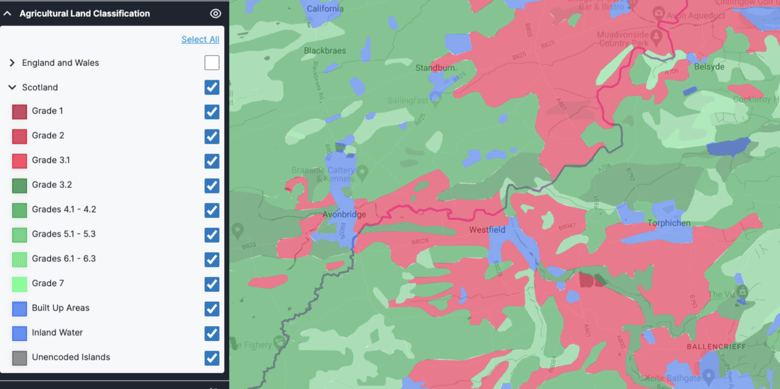
LandInsight already has an Agricultural Land Classification layer, letting you overlay grades against ownership, planning history, and other constraints from the outset. We've now introduced the new Predictive ALC dataset alongside it rather than replacing the existing layer, with a clear explanation of the difference between the two approaches. That way, you can see what the old Provisional map said, and what the new Predictive model says, and make your own informed call.
We'll be keeping customers updated as this comes together. If you want to be among the first to know when it's live, or if you're not yet using LandInsight for greenfield site assessment, it's worth a look.
For land professionals, the combination of a better ALC map and freely accessible soil data means the desktop phase of site assessment just got a bit sharper. That's worth knowing about.
Explore LandInsight today.