
A refused application can sink a scheme's viability overnight. Months of due diligence, a purchase under option, a build programme pencilled in - all of it rests on a decision made by a committee or a case officer who may never have visited the site. Getting planning permission right is where development risk concentrates, and it's rarely as simple as filling in a form.
Most guides to planning permission are written for homeowners extending a kitchen or converting a loft. This one isn't. Here, we're covering how the planning permission system actually works, what it costs, how long it takes, and - because this is the part homeowner guides skip entirely - how to judge your chances of approval before you commit to a site.
Key Highlights
- Planning permission is consent from the local planning authority to develop land or change its use, and getting it wrong is where development risk concentrates.
- There are several types of permission - full, outline, householder, prior approval, listed building consent, and lawful development certificates - and choosing the right route matters for developers.
- The standard process runs from pre-application advice through validation, consultation, and determination, with an 8-week target for minor applications and 13 weeks for major schemes.
- Costs and timescales vary by application type and local authority, and conditions attached to a permission can affect when and how you can start work.
- Reading planning history, local plan policy, and past appeal decisions before you buy a site is the difference between guessing at approval odds and knowing them.
- LandInsight brings planning history, constraints, and policy designations together on one map, so you can assess a site's potential before you commit capital.
What Is Planning Permission and When Do You Need It?
Planning permission is formal consent from the local planning authority (LPA) to carry out development, which includes building work, engineering operations, and material changes of use to land or buildings. The legal basis sits in the Town and Country Planning Act 1990 (itself building on the original 1947 Act), which created the framework requiring consent for development in England.
Not everything you do to a site counts as "development" in the legal sense, and not all development needs an application. Full guidance on when permission is and isn't required is set out on GOV.UK. The test runs in two stages:
- Is it development at all? Routine maintenance, internal alterations that don't affect the external appearance, and some uses of land fall outside the definition entirely.
- If it is development, does permitted development (PD) apply? Permitted development rights grant automatic consent for certain types of work, subject to conditions and limitations, without the need for a full application. For a detailed breakdown of what qualifies, see our guide to permitted development rights.
If your proposal clears both hurdles, you don't need to apply. If it doesn't, you're into the formal application process.
Types of Planning Permission
Not every application is the same, and picking the wrong route wastes time and money. Here's what developers need to know:
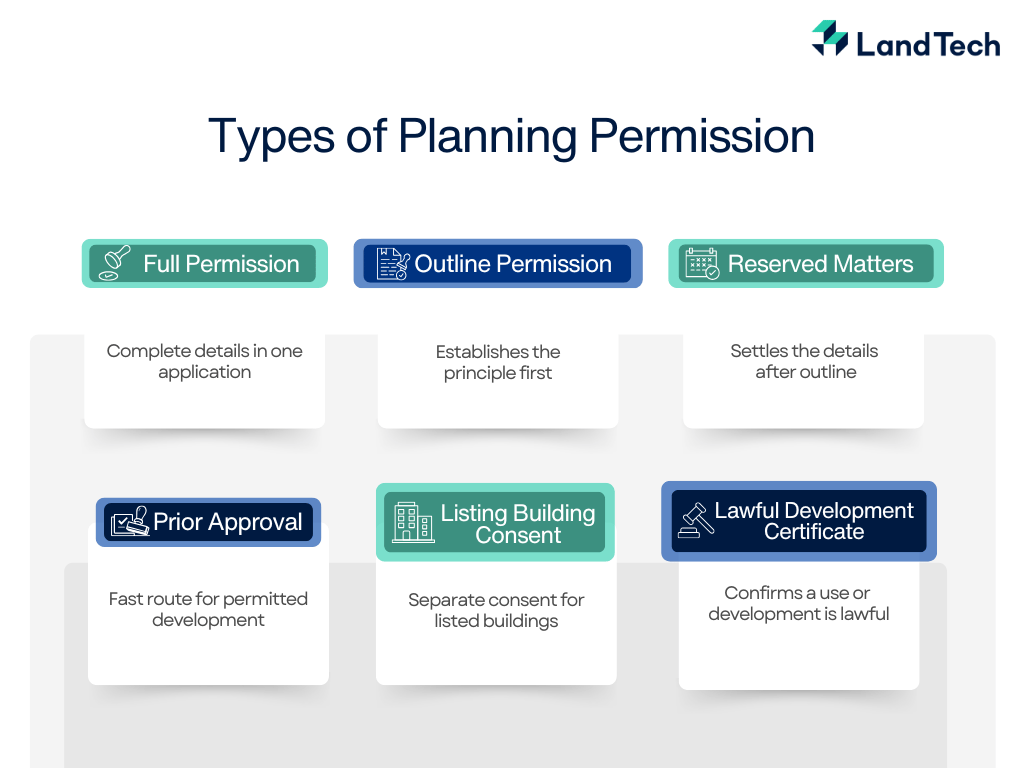
- Full planning permission covers the complete details of a proposal, including layout, design, and materials, in a single application. This is the most common route and the one most LPAs expect for anything beyond a straightforward scheme.
- Outline permission establishes the principle of development on a site before the detailed design work is done. It's a useful tool for developers wanting to test viability or de-risk a site acquisition before investing in detailed drawings.
- Reserved matters applications follow an approved outline permission and settle the details - appearance, landscaping, layout, scale, and access - that weren't fixed at the outline stage.
- Householder permission applies to alterations and extensions to a single dwelling house. It's the category most homeowner-focused guides cover, and it's rarely relevant to commercial or multi-unit development.
- Prior approval sits between permitted development and a full application. Certain PD rights require the developer to notify the LPA and seek confirmation that specific matters (such as flooding risk or transport impact) have been considered, even though full permission isn't needed.
- Listed building consent is a separate consent required for any work affecting a listed building's character, in addition to (or instead of) planning permission.
- Lawful development certificate confirms that an existing use or development is lawful, or that a proposed use or development wouldn't require permission. It's often used to provide certainty before a sale or a mortgage application.
For developers working on commercial schemes, most applications fall under full or outline permission, with reserved matters following where outline consent has already been secured. Commercial planning permission doesn't differ procedurally from residential permission, but the supporting evidence base - transport assessments, commercial viability appraisals, and environmental information - tends to be more substantial.
How to Get Planning Permission, Step By Step
The process is broadly consistent across England, though timescales and local requirements vary by authority. GOV.UK sets out the formal application steps in full; here's how it runs in practice:
The process is broadly consistent across England, though timescales and local requirements vary by authority. GOV.UK sets out the formal application steps in full; here's how it runs in practice:
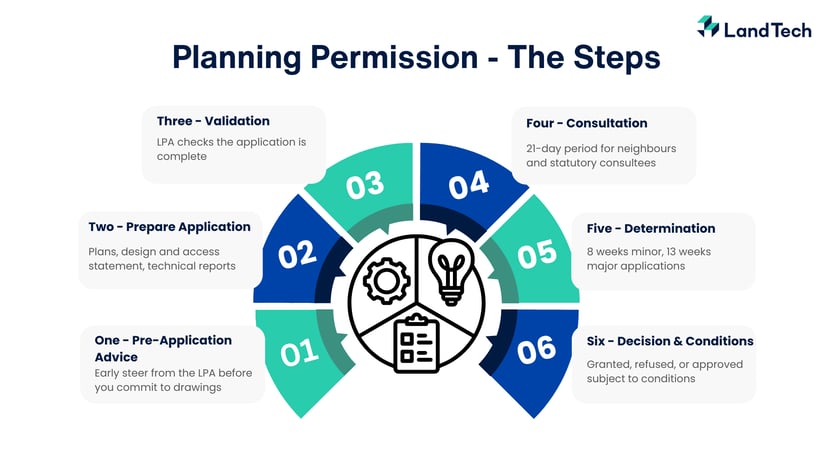
- Pre-application advice. Most LPAs offer a pre-application service, usually for a fee, where planning officers give an early steer on a proposal's likely acceptability. It's not binding, but it flags major objections before you've spent money on detailed drawings.
- Prepare the application and supporting documents. This typically includes scaled plans and drawings, a design and access statement, and - depending on the scheme's scale and location - technical reports covering flood risk, ecology, heritage, transport, or noise.
- Validation. The LPA checks the application is complete against its local validation checklist. An incomplete submission gets bounced back before the clock even starts, so getting this right first time matters.
- Consultation. Once validated, the application is publicised, and there's normally a 21-day period for neighbours, parish or town councils, and statutory consultees (such as the Environment Agency or Highways) to comment.
- Determination. The statutory target is 8 weeks for minor applications and 13 weeks for major developments, though in practice many authorities run over this, particularly for larger or contentious schemes. Extensions of time are common and are usually agreed by mutual consent between the applicant and the LPA.
- Decision and conditions. Permission is granted, refused, or granted subject to conditions. Conditions can cover anything from materials and landscaping to pre-commencement requirements that must be discharged before work starts on site.
At each stage, the developer's job is to reduce uncertainty for the case officer. That means engaging early, providing a complete and well-evidenced application, and responding quickly to consultation feedback rather than letting objections sit unanswered.
Costs, Timescales, and Conditions
Application fees are set nationally but reviewed periodically, so it's worth checking the current schedule using the Planning Portal's fee calculator rather than relying on a figure that may already be out of date. Community Infrastructure Levy and Section 106 contributions sit alongside application fees once a scheme is approved; our guide to CIL and planning obligations covers how these are calculated and when they apply.
On timescales, the 8-week and 13-week statutory periods are targets, not guarantees. Delays commonly come from incomplete submissions at validation, requests for further information during consultation, or committee scheduling for applications that can't be decided under delegated powers. Our data deep dive on planning determination periods looks at how actual council performance compares to the official statistics, and why building contingency into your programme is sensible, particularly for major schemes.
Conditions attached to a permission are just as important as the decision itself. Some conditions must be discharged before development begins (pre-commencement conditions); others apply throughout construction or before occupation. It's also worth knowing the 3-year commencement rule: a full planning permission normally lapses if development hasn't started (a "material start", which has its own legal definition) within three years of the decision date. Missing that window means reapplying from scratch.
How Developers Assess Approval Likelihood Before Buying
This is the part almost no planning permission guide covers, because almost none of them are written for developers weighing up whether to buy a site in the first place.
Before you commit capital, three things tell you far more than the LPA's published policy alone:
- The local plan and NPPF position. Every site sits within a local plan designation - allocated, protected, or somewhere more ambiguous - and against the National Planning Policy Framework's presumption in favour of sustainable development. Understanding where a site sits against both is the starting point for any credible assessment. Our guide to the NPPF explains how the framework shapes decisions, and our data snapshot on out-of-date local plans shows why relying on local plan status alone can be misleading. Green Belt sites carry their own additional layer of restriction; see our guide to getting planning permission in the Green Belt for the current viable routes.
- Planning history on the site itself. Previous applications, refusals, and appeal decisions on a site (or on comparable sites nearby) are the clearest indicator of what an LPA is likely to accept. A pattern of refusals for similar schemes in the same area is a warning sign worth taking seriously before you exchange.
- Precedent from nearby decisions and appeals. Even where a site has no planning history of its own, decisions on neighbouring or comparable sites reveal how the LPA is applying policy in practice, which is often more telling than the policy wording itself.
Pulling all of this together manually, site by site, is slow. It usually means separate searches across the LPA's planning portal, the Planning Inspectorate's appeal decisions, and the local plan documents, before you've even started assessing the site itself.
LandInsight brings planning history, constraints, and policy designations together on one map, so you can judge a site's approval odds before you commit capital rather than after. It's built for exactly this stage of the process: the point where you need a fast, evidence-based read on a site's potential, not another spreadsheet of unlinked data.
FAQs
-
How long does planning permission take? The statutory targets are 8 weeks for minor applications and 13 weeks for major developments, though actual timescales often run longer. See our data deep dive on planning determination periods for a detailed breakdown of how actual council performance compares.
-
How much does planning permission cost? Fees depend on the type and scale of application and are set nationally, though the schedule is reviewed periodically. Use the Planning Portal's fee calculator for the current figure, and see our guide to CIL and planning obligations for the costs that follow approval.
-
What is the difference between full and outline permission? Full permission covers the complete design in one application, while outline permission establishes the principle of development first, with the detailed design settled later through a reserved matters application.
-
Can you start work before permission is granted? No. Starting work without the necessary consent risks enforcement action, and any development carried out before permission is granted isn't protected, even if the application is later approved. Where work has already started or finished without consent, a retrospective application may be an option, though LPAs assess these on the same merits as any other application, with no guarantee of approval.
-
What happens if planning permission is refused? You can appeal the decision to the Planning Inspectorate, amend and resubmit the application, or reconsider the scheme's design in light of the refusal reasons. Our guide to how long planning appeals take covers what to expect from the process.
Judge the Odds Before You Buy
Planning permission is where development risk lives. The developers who win aren't necessarily the ones with the best schemes on paper; they're the ones who can read a site's chances before they buy. LandInsight brings planning history, constraints, and policy onto one map, so you can judge a scheme's odds from day one.