

You've spotted a tired office block on a busy high street. The ground floor has been empty for two years. Could it become flats without a full planning application?
It could. And for the developers who know how to use permitted development rights, that question gets answered fast.
Most guides on this topic are written for homeowners wanting to extend their kitchen. This one is for developers. We'll cover what permitted development rights actually are, the mechanism behind them, the classes that matter most for development, and how to spot PD potential at scale - before anyone else does.
The PDR landscape is also moving right now. A government consultation on protecting community assets from demolition via PD - covering youth centres, community halls and similar buildings - is open until August 2026. A separate consultation on a new small-scale onshore wind turbine right has just closed, so it's one to watch rather than something you can rely on yet. We've covered both below.
Key Highlights
- Permitted development rights (PDRs) let certain developments go ahead without a full planning application. They're granted by Parliament through the General Permitted Development Order 2015 (GPDO), not by your local council.
- Most developer-relevant PDRs still require prior approval - a faster, narrower-scope process than a full planning application, with a statutory 56-day decision window.
- Class MA is the key route for commercial-to-residential conversion, letting Class E buildings (shops, offices, restaurants, gyms and more) convert to residential use. The 2024 changes removed the 1,500 sqm floorspace cap and the three-month vacancy requirement.
- Class Q and Class R cover agricultural building conversions - to residential and to commercial use respectively - while Class ZA permits demolition and rebuild of eligible vacant buildings.
- PDRs don't apply to flats or listed buildings, and are more restricted in conservation areas, AONBs, National Parks and other Article 2(3) land.
- Article 4 directions can remove PDRs in specific areas, so checking whether one applies to your site is essential before relying on permitted development.
- A Lawful Development Certificate (LDC) formally confirms a scheme is lawful and is close to non-negotiable for PD-led projects.
- LandInsight shows use class, planning history and Article 4 constraints across a whole search area at once, so developers can spot PD potential at scale rather than site by site.
What Is Permitted Development?
So what is permitted development, in practical terms? It's development that's already been pre-approved at a national level, meaning you can proceed without submitting a full planning application, provided your scheme meets the relevant criteria.
Permitted development rights (PDRs) are the rights that make this possible: rights granted by Parliament - not your local planning authority - that allow certain types of development to go ahead without needing consent from the council each time.
The legal definition of 'development' is broad. Under Section 55 of the Town and Country Planning Act 1990, it covers everything from structural alterations and construction, to material changes in the use of land or buildings. Most development requires planning permission. Permitted development is the exception - a category of works and changes that are already pre-approved, provided they meet specific criteria.
The key distinction: planning permission is granted (or refused) by your Local Planning Authority, based on local policy and their own judgement. Permitted development rights are granted by the central government through the General Permitted Development Order 2015 (GPDO), and if your scheme complies with the rules, the LPA's hands are largely tied.
For developers, this changes the risk profile of a project considerably. Speed and certainty are where PD earns its value - not just convenience.
How Permitted Development Works: The GPDO Explained
The GPDO is the mechanism that makes all of this possible. Originally established in the post-war planning system from 1948, the GPDO has been updated repeatedly, most recently through the current 2015 Order and its subsequent amendments, including The Town and Country Planning (General Permitted Development etc.) (England) (Amendment) Order 2026.
Schedule 2 of the GPDO is where the detail lives. It sets out a series of Parts (broad categories) and Classes within them. Each Class defines what's permitted, under what conditions, and with what limitations. This structured system is what lets developers and their advisors assess - with a reasonable degree of clarity - whether a proposed scheme qualifies as permitted development.
Prior Approval: What It Means In Practice
Here's the bit many people get wrong: most developer-relevant PDRs don't mean you simply get on with the work. They require prior approval from the LPA first.
Prior approval is not the same as a full planning application. The LPA can only consider the specific matters listed in the relevant Class - typically things like transport impacts, contamination, flood risk, noise, and natural light. They cannot refuse on design grounds or neighbourhood character unless those are specifically listed. That narrower scope is what makes prior approval faster and more predictable than a conventional application.
The statutory timescale for a prior approval decision is 56 days (8 weeks), which is roughly comparable to a minor planning application. The difference is what the LPA can and can't look at - and that focused scope is what makes PD attractive.
For detailed technical guidance on the GPDO and each prior approval class, the government's permitted development technical guidance is the authoritative source.

Types of Permitted Development
There are two broad types of PDR. Those that don't require prior approval are generally lower-impact - small domestic works, minor alterations - and you can proceed without any notification (though a Lawful Development Certificate is always recommended for peace of mind). Those that do require prior approval are where the developer opportunity sits.
Householder Rights (Schedule 2, Part 1)
Single-storey rear extensions (up to 4m for detached, 3m for semi or terrace - or up to 8m/6m under the Neighbour Consultation Scheme via prior approval), loft conversions (up to 50m³ for detached and semi-detached, 40m³ for terraced), and porches and solar panels all fall under householder rights. So does permitted development for outbuildings, provided they don't exceed 50% of the original curtilage - one of the more commonly used householder rights, and a source of confusion for anyone converting a garden building into something more permanent.
These rights are worth knowing - they inform how occupiers and smaller property owners use the system - but they're not where the development opportunity lies. So let's move on.
Change of Use: The Developer Goldmine
This is where permitted development change of use rules become genuinely powerful for professional developers. The following classes all require prior approval, but bypass the full planning process entirely.
-
Class MA - Commercial to Residential (Class E to C3)
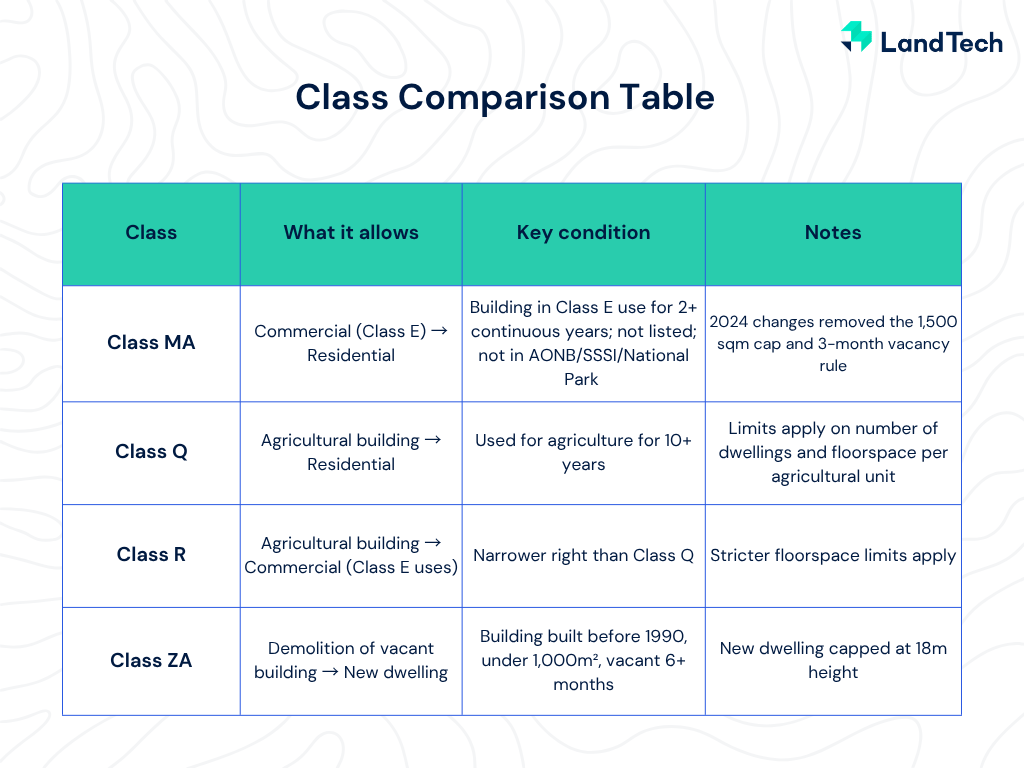
Introduced in 2021 as the successor to the old Class O (offices to resi) rights, Class MA is now the most significant PDR for developers working with commercial stock - effectively the modern office to residential permitted development route. It allows buildings in Class E use - which captures shops, offices, restaurants, cafés, gyms, light industrial, and more - to be converted to residential (C3) use via prior approval.
The conditions that apply: the building must have been in Class E use for a continuous period of at least two years before the application; it must not be a listed building; and it must not sit in an AONB, SSSI, or National Park. Prior approval will consider transport impacts, contamination, flood risk, noise from commercial premises, natural light provision, and the impact on the supply of local commercial space.
Importantly, two significant restrictions were removed in March 2024: the 1,500 sqm floorspace cap, and the requirement for the building to have been vacant for three months before application. Class MA now applies to buildings of any size, including those still in active commercial use. This significantly expanded the pool of eligible sites.
-
Class Q - Agricultural Buildings to Residential
Class Q permits the conversion of agricultural buildings to dwellinghouses (C3), subject to prior approval. The prior approval matters include transport, noise, contamination, flood risk, and natural light. The building must have been used for agriculture as part of an agricultural unit for at least 10 years. There are limits on the number of dwellings that can be created across any given agricultural unit, and on the cumulative floorspace.
Class Q is a well-established route for rural development - converting redundant barns and farm buildings into homes without needing planning permission. The key constraint is demonstrating the building is genuinely suitable for conversion (structural integrity matters here) and that the prior approval criteria are met.
-
Class R - Agricultural Buildings to Commercial Uses
Where Class Q enables agricultural to resi, Class R covers agricultural to certain Class E uses (including retail, offices, and light industrial). It's a narrower right with stricter floorspace limits, but it's another route worth knowing.
-
Class ZA - Demolition and Rebuild
Since September 2020, developers can demolish a vacant or redundant building and replace it with a new dwellinghouse, subject to prior approval. The building must have been built before 1990, be under 1,000m², and have been vacant for at least six months. The new dwelling must not exceed 18m in height. This right applies to certain commercial buildings and residential buildings - see the GPDO for the specific eligible classes. It gives developers a route to start from scratch without being constrained by an existing building's configuration.
-
Small-Scale Onshore Wind Turbines - Proposed New Class (Under Consultation)
As of June 2026, the Department for Energy Security and Net Zero is consulting on a new PDR that would allow a single non-domestic wind turbine up to 30m in height to be installed on farms, commercial sites, and public sector land without a full planning application. The proposal includes prior approval requirements covering noise, visual impact, and proximity to dwellings. It would not apply to homes, domestic gardens, or designated areas such as National Parks and National Landscapes. This is a live consultation closing later in 2026 - not yet law, but worth watching closely if you're working on rural or commercial sites.
-
Class E (Use Class) - Commercial Flexibility
It's worth noting that changes of use between different uses within Class E - say, a shop to an office, or a café to a gym - are not development at all. No permission of any kind is required, because you're not changing use class. This is class E permitted development in the loosest sense: no PD application needed, because none of it counts as development to begin with. It makes Class E buildings highly flexible assets for operators, though not directly relevant to the residential conversion opportunity.
Extended Permitted Development: Adding Storeys
Since September 2020, certain buildings can have additional storeys added under permitted development - commonly known as the 'right to rise'. This applies to purpose-built blocks of flats, detached and terraced houses, and some commercial and mixed-use buildings, where the original structure was built between 1st July 1948 and 5th March 2018.
Extensions are capped at two additional storeys, up to a maximum height of 30m (for blocks of flats and commercial use) or 18m (for residential buildings). Prior approval is required.
Permitted Development Rules, Limits, and Conditions
Permitted development rights don't apply universally. Knowing when they're restricted or removed is just as important as knowing when they apply - and permitted development rules UK-wide are not uniform, so where your site sits matters as much as what you're proposing to do with it.
When PDR Does Not Apply
Flats and maisonettes do not benefit from householder permitted development rights. The rights discussed above (extensions, loft conversions, outbuildings) apply to houses, not flats. Many developers are caught out by this.
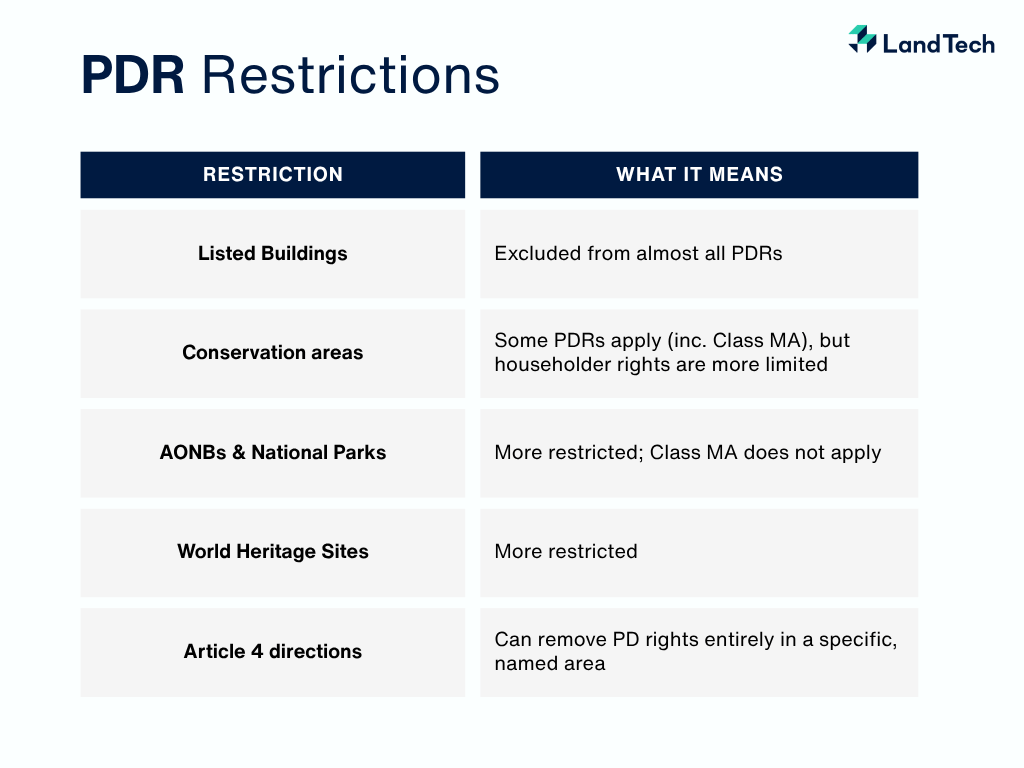
Listed buildings are excluded from almost all PDRs. Any development affecting a listed building requires listed building consent as well as, in most cases, planning permission.
Geographical Restrictions
Permitted development rights apply across England. Scotland, Wales, and Northern Ireland operate under similar but separate legislative frameworks - always check the specific rules for devolved nations, since permitted development rules UK-wide diverge significantly once you leave England.
Within England, several designations restrict or remove PDRs:
- Conservation areas - some PDRs apply (including Class MA), but permitted development in a conservation area is more restricted for householder rights, and works affecting the external appearance of a building often require permission
- Areas of Outstanding Natural Beauty (AONBs) - more restricted; Class MA does not apply
- National Parks - more restricted; Class MA does not apply
- The Broads - treated similarly to National Parks
- World Heritage Sites - more restricted
These are sometimes collectively referred to as 'Article 2(3) land'.
Article 4 Directions
Local authorities can remove permitted development rights in specific areas through Article 4 directions. These must be approved by the Secretary of State and are typically used to protect areas of acknowledged importance - employment zones, historic areas, or areas where prior approval rights are considered to risk displacing important uses.
Some LPAs attempt to apply Article 4 directions across their entire area, though these tend to face challenges before coming into force. More commonly, Article 4 directions are targeted - covering a named street, an employment area, or a specific use class.
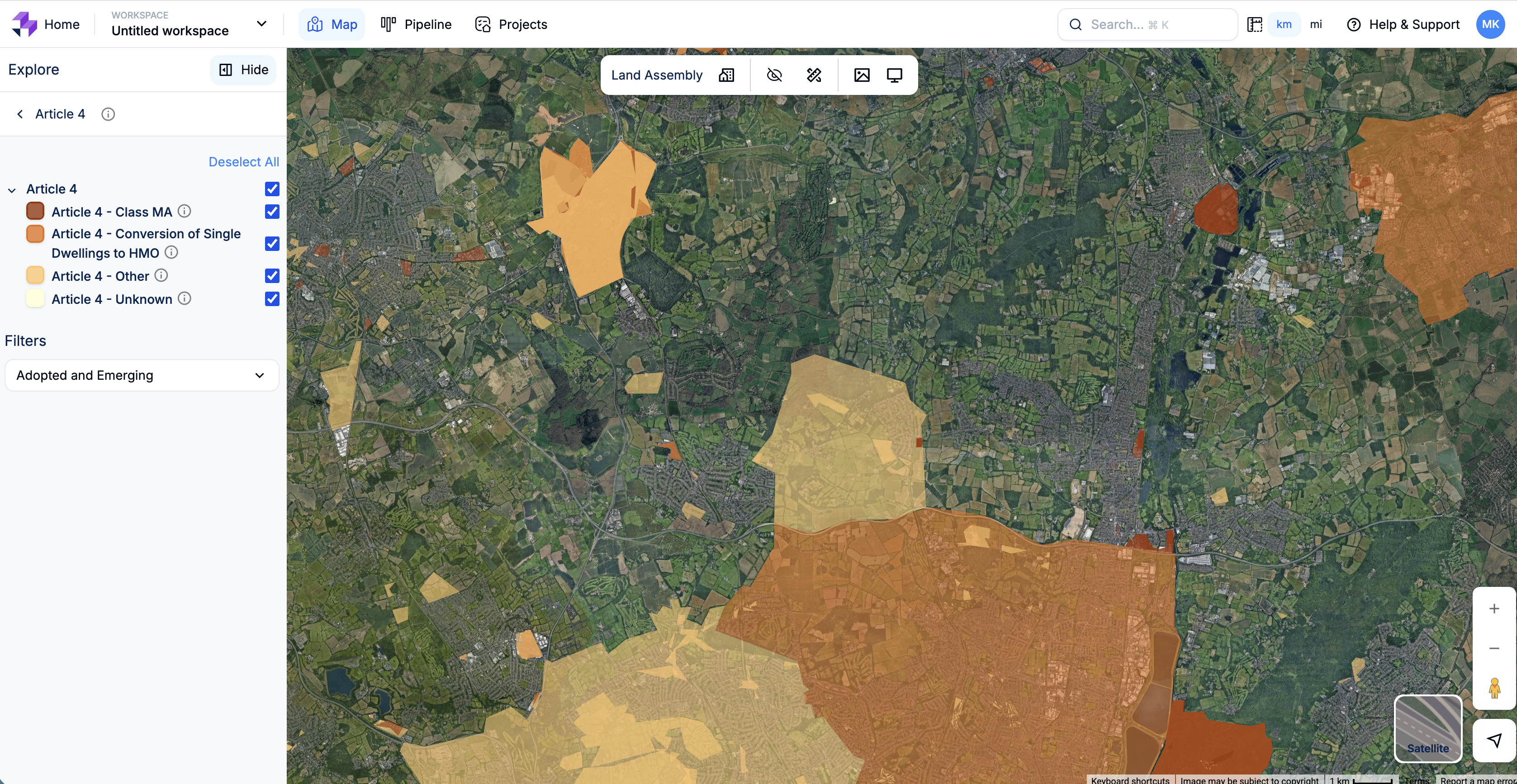
Article 4 directions can remove rights that would otherwise apply anywhere in England. Before progressing any PD scheme, checking whether an Article 4 direction affects the specific site is essential. LandInsight lists Article 4 directions on the map - you can check this for any site instantly.
June 2026: Community Assets and Schools - What's Proposed
In June 2026, the Ministry of Housing, Communities and Local Government launched a consultation proposing two further restrictions on permitted development rights.
The first is significant for developers eyeing vacant community buildings: the proposals would remove PD demolition rights for buildings designated as assets of community value - youth centres, community halls, and similar - giving them the same protections that pubs already have. Under the current rules, demolition of these buildings can proceed via PD without community input. If the proposal is enacted, full planning permission would be required, giving local communities a formal voice.
The second proposal relates to schools, specifically those with buildings affected by reinforced autoclaved aerated concrete (RAAC). The government is proposing to extend PD rights to allow schools to erect temporary replacement buildings more quickly, without planning delays.
Both are currently at consultation stage, with responses closing in August 2026. Neither has legal effect yet, but if you are acquiring or assessing sites that include community buildings, this is a risk worth factoring in.
Size, Height, and Conditions
Each PDR Class comes with its own set of limitations - size, height, materials, curtilage coverage. The 50% curtilage rule for outbuildings is a common one; extensions must use materials that match the existing building; dormers cannot face the highway. The conditions vary by Class, and the GPDO detail is what governs. Always read the relevant Class in full rather than relying on a summary.
How Developers Spot Permitted Development Potential At Scale
Understanding the rules is one thing. Finding the sites that meet them - across a whole search area, quickly, before anyone else - is another problem entirely.
The manual approach has two versions. The first: hire an agent and pay for the privilege. The second: drive around, identify buildings by eye, then spend weeks trying to track down ownership and confirm planning status. Neither scales.
The Lawful Development Certificate
Before committing to any PD scheme, a Lawful Development Certificate (LDC) is the mechanism for de-risking it. An LDC is a formal confirmation from the LPA that a proposed scheme does (or did) constitute lawful development. It's not legally required, but it provides certainty - and lenders, solicitors, and future buyers will want it. For sites where permitted development is the entire basis of the scheme, an LDC is close to non-negotiable.
Checking Article 4 and Constraints Manually
You can check whether a site sits within a conservation area, AONB, or National Park through planning authority mapping. Article 4 directions are less consistently published but can usually be found via your LPA's planning department or through national planning data portals. This works for individual sites; it doesn't work if you're trying to screen dozens of sites at once.
LandInsight: Check PDR Potential At Scale
LandInsight's Property Information layer shows use class, planning history, and Article 4 areas on the map, across an entire search area at once. Rather than checking sites one by one, you can filter for Class E properties, overlay Article 4 constraints, and surface sites with prior approval history - in the time it would take to research a single address manually.
That's the difference between finding one opportunity and finding fifty.
FAQs
-
What is the difference between permitted development and planning permission?
Planning permission is granted by your Local Planning Authority and involves a discretionary assessment against local and national planning policy. Permitted development is a pre-existing national permission; if your scheme meets the criteria set out in the GPDO, the LPA's scope to refuse is limited. Prior approval (required for most developer-relevant PDR classes) is a lighter-touch process than full planning, focused on a defined set of matters rather than a holistic policy assessment.
-
Do permitted development rights apply to flats?
Not for householder rights. Extensions, loft conversions and outbuildings are not permitted development for flats or maisonettes - those rights apply only to houses. However, flats are not excluded from all PDRs; Class MA conversions can create flats, and certain other rights may apply depending on the building type.
-
What is an Article 4 direction?
An Article 4 direction is an instruction issued by a local planning authority (and approved by the Secretary of State) that removes specified permitted development rights in a defined area. It effectively means that development which would otherwise be permitted nationally requires a full planning application locally. Article 4 directions are most common in conservation areas and areas the LPA wants to protect from change.
-
Do I need prior approval for permitted development?
It depends on the class. Many developer-relevant PDRs - including Class MA, Class Q, and the right to rise - require prior approval from the LPA before work can begin. Householder PDRs for minor works (such as small extensions under certain thresholds) generally do not require prior approval, though the Neighbour Consultation Scheme applies to larger rear extensions.
-
Can permitted development rights be removed?
Yes. The government can amend the GPDO and remove or restrict rights (and has done so repeatedly over the years). Local authorities can also remove rights for specific areas via Article 4 directions. Rights can also be removed by conditions attached to an existing planning permission on a specific site. Always verify that PDRs apply to your specific property before relying on them.
-
What changed with Class MA in 2024?
As of 5 March 2024, the 1,500m² floorspace cap and the three-month vacancy requirement were both removed from Class MA. Commercial buildings of any size can now be converted to residential under permitted development, including buildings that are still in active use. The requirement for two years of continuous Class E use remains, as does the prior approval process.
Where Do You Start?
Permitted development rights are one of the most powerful tools available to developers - but only if you can identify where they apply before the competition does. The rules alone won't find you sites.
LandInsight shows use class, planning history and Article 4 constraints across any search area, so you can identify PD opportunities at scale.

This guide reflects the rules in force as of June 2026, including the GPDO 2015 as amended by SI 2026/313. Two MHCLG and DESNZ consultations launched in June 2026 propose further changes - these are noted in the guide but are not yet law. Permitted development rights are subject to change. Always verify the current position and take professional advice before acting.