

Every planning decision made in England gets held up against one document: the National Planning Policy Framework, or NPPF. Understand it, and you can read a site's chances before you've even made an offer. Misread it, and you'll find out the hard way, usually at appeal.
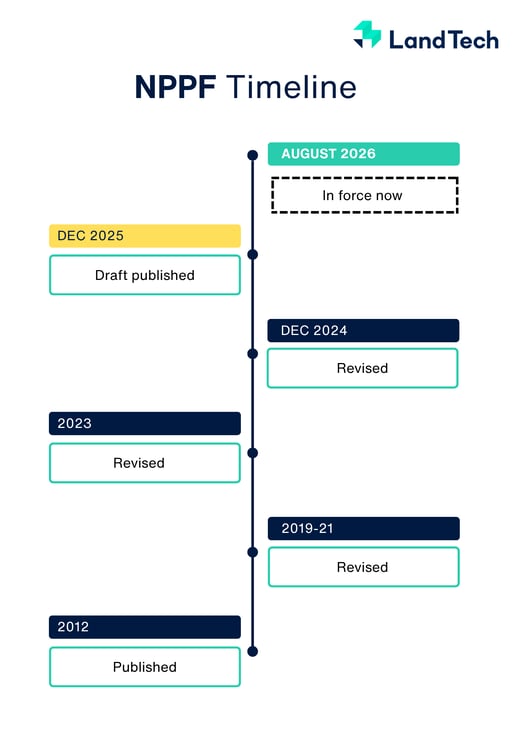
The framework has also had a busy couple of years. The December 2024 rewrite introduced grey belt, a new method for calculating housing need, and a target of 1.5 million homes this Parliament. That set the direction, but the NPPF 2026, published on 17th August 2026, goes much further: it's the first comprehensive rewrite of the Framework since 2012, and it's already in force.
This guide covers what the NPPF actually is, how it shapes the decisions that make or break a scheme, and what changed in the NPPF 2026.
Key Highlights
- The NPPF is the government's planning rulebook for England - it doesn't grant or refuse permission itself, but every decision is judged against it.
- It sits above local plans, and where a local plan is absent, outdated, or under strain, the NPPF carries even more weight.
- The NPPF 2026, published 17 August 2026, is the first comprehensive rewrite since 2012 and is already in force for decisions.
- The old tilted balance is gone. A permanent presumption in favour of sustainable development (policies S3 to S6) now governs every decision, split between sites inside and outside settlements.
- Homes near well-connected stations now have a confirmed route to approval, even in the green belt, with minimum densities of 35 to 45 dwellings per hectare.
- Grey belt is retained and embedded further into the NPPF 2026, golden rules and all.
- LandInsight surfaces the policy layers behind these rules - green belt, grey belt, conservation areas, flood zones, and more - directly on a site, so you can apply the NPPF in practice rather than reading about it in theory.
What is the NPPF?
The National Planning Policy Framework is the government's set of planning policies for England. Think of it as the rulebook that both local authorities and developers are working from, whether they're drafting a local plan or deciding whether your extension gets the green light.
It covers a lot of ground: housing delivery, economic growth, transport, the natural and historic environment, green belt, and heritage protection, to name a few. Rather than dictating outcomes site by site, it sets the principles that everything else has to work within.
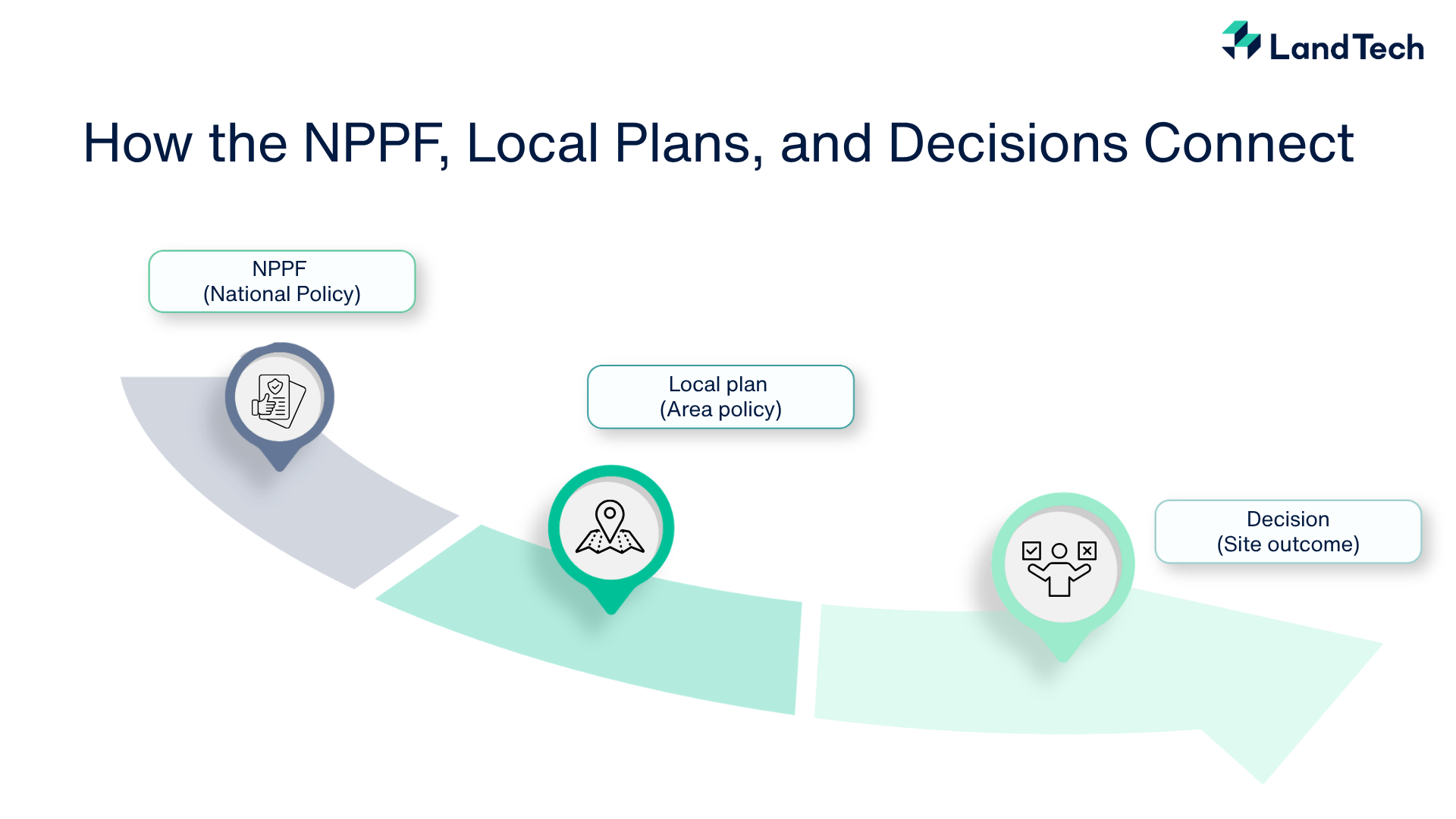
Importantly, the NPPF isn't law. It's a material consideration, which in planning terms means decision-makers have to take it into account and give it due weight, but it doesn't override everything automatically. It sits above local plans, which are where national policy gets translated into decisions for a specific area. When a local plan is sound and up to date, it tends to do most of the heavy lifting. When it isn't, the NPPF steps forward.
How the NPPF Shapes Planning Decisions
England runs on what's called a plan-led system. Plan-making policies guide the preparation of local plans and, under the NPPF 2026, spatial development strategies at a larger sub-regional scale too. Local plans then guide the decisions made on individual applications. In an ideal world, every authority has a current, adopted local plan, and most decisions are relatively predictable.
The NPPF 2026 has restructured how the Framework itself works. Policies now split into two families: plan-making policies, which authorities use when preparing plans, and national decision-making policies, which apply directly when an application is decided, whether or not the local plan has caught up. That split runs through every chapter, and it's the single biggest structural change in this rewrite.
It's also where the presumption in favour of sustainable development lives, and this is the part of the page that needed the most work. Previously, decision-makers applied what planners called the "tilted balance": in short, permission should generally be granted unless the plan was up to date and the scheme conflicted with it, or the harm from a scheme clearly and demonstrably outweighed the benefits. That mechanism, in old paragraph 11, has gone.
In its place, the NPPF 2026 sets out a permanent presumption in favour of sustainable development, split by geography:
- Inside a settlement (policy S4), development should be approved unless its benefits are substantially outweighed by adverse effects.
- Outside a settlement (policy S5), only certain forms of development qualify: agricultural and rural uses, reuse of existing buildings, previously developed land, limited infilling, exception sites and, significantly for developers, housing near well-connected stations and land meeting an evidenced unmet housing need. Anything outside that list needs exceptional circumstances.
- Where a site straddles a settlement boundary, S4 and S5 are applied separately to the relevant parts before the decision-maker reaches an overall view.
The presumption doesn't apply to green belt or Local Green Space — those sit under their own policies instead (more on grey belt below). And where a scheme conflicts with a recently adopted neighbourhood plan that contains its own housing allocations, the presumption tips against it.
For a developer, the underlying logic hasn't changed: it's often still the difference between a site that's realistically deliverable and one that isn't, and it's still worth looking closely at any authority with a stale local plan or a shaky housing land supply (more on that in our local plan guide). What's changed is the mechanics you'd cite in a planning statement.
What the NPPF 2026 Changed
The December 2024 changes set the direction: grey belt, a tougher standard method for housing need, and the 1.5 million homes target. The NPPF 2026 rewrite goes much further, restructuring how the Framework works and confirming several genuinely significant changes for developers.
The Permanent Presumption
Covered in detail above: the tilted balance is gone, replaced by a permanent presumption in favour of sustainable development (policies S3 to S6), split between sites inside and outside settlements.
Station Connectivity: Now
The NPPF 2026 confirms a route to approval for residential and mixed-use development within reasonable walking distance (around 800 metres) of a well-connected station, including on green belt land, provided the scheme is physically well related to the station or settlement and local infrastructure can support it. "Well-connected" now covers stations in the top 80 Travel to Work Areas by Gross Value Added, up from the top 60 proposed at consultation. Minimum densities apply too: at least 35 dwellings per hectare within reasonable walking distance, rising to 45 where a station is served at twice the minimum required frequency - both lower than the 40/50 dph the December 2025 draft proposed. We've gone into how to find qualifying sites in LandInsight in this piece, which we're updating separately now this is confirmed policy rather than a draft.
The New Medium Development Category
Alongside "major" development, the NPPF 2026 introduces a medium development category: broadly, housing schemes of 10 to 49 homes on sites up to 2.5 hectares. Authorities are expected to scale information requirements to reflect it, which should mean a lighter-touch process for mid-sized schemes that previously got treated the same as much larger sites.
A 30-Month Plan-Making Timetable
Local plans now run to a fixed clock: 30 months from the point an authority publishes its Gateway 1 self-assessment to adoption. It's a genuinely useful developer angle — authorities under that kind of time pressure on evidence and site identification tend to create allocation opportunities for promoters who engage early.
Preventing "Gold-Plating"
The NPPF 2026 tightens what local plans can require beyond national baselines. Quantitative standards for things like accessibility, water efficiency and energy efficiency now need a clear, costed rationale showing no adverse impact on viability - authorities can't simply stack local requirements on top of Building Regulations without justifying them.
Housing Delivery Test and Statutory Consultee Reform
Published alongside the Framework: the 2024 and 2025 Housing Delivery Test results (2025 is what's used for live decisions now) and the government's response to the statutory consultee reform consultation. Sport England keeps its statutory consultee status, but only for schemes affecting playing fields; the Gardens Trust and Theatres Trust lose theirs, replaced by a notification right; and Active Travel England, National Highways, Historic England and the Mining Remediation Authority - the busiest consultees by volume - are being reformed to cut unnecessary referrals.
Transitional Arrangements: What Applies When
Decision-making has no grace period: the national decision-making policies, including the new presumption, apply to any application or appeal decided from 17 August 2026 onwards, regardless of when it was submitted. Plan-making is phased: authorities have until 31 December 2026 to submit local plans for examination under the outgoing system, where they'll still be examined against the December 2024 NPPF; anything submitted after that follows the NPPF 2026. Neighbourhood plans follow a similar split - those submitted by 17th August 2026 can continue under the 2024 Framework or be withdrawn and updated, while later submissions must follow the new rules. In practice, a live application can be judged against the NPPF 2026 even while the local plan sitting alongside it was written for the version it replaced.
Grey Belt: Retained, Not Reworked
Grey belt survives the rewrite largely intact: it's still previously developed green belt land, or land that doesn't strongly contribute to green belt purposes, and it's now embedded across both plan-making and decision-making policy rather than sitting as an add-on. The golden rules continue too, with a little more flexibility than the consultation draft proposed: affordable housing is typically set at 15 percentage points above the highest applicable local policy requirement, capped at 50%, rather than a blanket 50% figure. There's also a narrower route to a viability assessment where the golden rules can't be met - on previously developed land, a strategic site, or a development type genuinely different from what the plan's viability evidence assumed.
What the NPPF Means for Finding and Assessing Sites
All of this is useful context, but the real question for most developers is simpler: does the NPPF make this particular site more or less promising?
In practice, that comes down to reading the policy designations sitting on and around a site early, before you've sunk time into it. Is it in the green belt, and if so, could it qualify as grey belt? Is it in a conservation area, or a flood zone that changes the viability calculation? And zooming out a little: does the local authority have an up-to-date local plan, and can it demonstrate a five-year housing land supply, or is the tilted balance realistically in play?
Getting to these answers usually means piecing together several different sources, which eats into time you'd rather spend on the sites that are actually worth pursuing. This is where LandInsight comes in: it surfaces national and local policy layers, green belt, grey belt, conservation areas, flood risk, and more, directly on a site, so you're applying the NPPF in practice rather than cross-referencing documents by hand.
See how national and local policy applies to any site with LandInsight.

FAQs
-
Is the NPPF law?
No. It's a national planning policy and a material consideration in decision-making, but it isn't a statute. Decisions are judged against it rather than governed by it directly.
-
How often is the NPPF updated?
It's been revised several times since it was first published in 2012, most recently with the comprehensive August 2026 rewrite. There's no fixed review cycle; updates tend to follow shifts in government housing policy.
-
What's the difference between the NPPF and a local plan?
The NPPF is a national policy that applies across England. A local plan is prepared by an individual local authority and sets out how that national policy applies in their area, including specific site allocations. Read more in our local plan guide.
-
What is the presumption in favour of sustainable development?
It's the principle, set out in policies S3 to S6 of the NPPF 2026, that development should be approved without unnecessary delay: inside settlements unless the harm substantially outweighs the benefits, and outside settlements for a defined list of development types - including housing near well-connected stations - unless that same test isn't met.
-
What changed in the new NPF 2026?
The NPPF 2026, published 17 August 2026, replaced the tilted balance with a permanent presumption in favour of sustainable development, confirmed a route to approval for homes near well-connected stations, introduced a medium development category and a 30-month local plan timetable, and kept grey belt and its golden rules in place.
-
What is grey belt land?
A category of green belt land, introduced in December 2024 and retained in the NPPF 2026, that's previously developed or doesn't strongly contribute to green belt purposes, and which faces a lower bar for development if golden rules on affordable housing, infrastructure and green space are met. Full details in our grey belt guide.
The Bottom Line
The NPPF sets the rules that every planning decision in England gets measured against. Knowing how to read it, and staying on top of what's changing, is how developers spot opportunity before everyone else catches up. LandInsight brings national and local policy onto every site, so you can apply it in seconds rather than in hours.

Related Reading
- The New NPPF in Action: Policy Hierarchy Masterclass
- The NPPF Playbook: Navigating Policy Hierarchy with Decision-Making Policies and Local Plans
- How to Find NPPF Station Connectivity Sites in LandInsight
- What is Grey Belt Land: The Definitive Developer's Guide
- Permitted Development Rights: A Complete Guide for UK Developers