

The draft NPPF published in December 2025 introduced one of the most significant policy shifts for site finding in years: a default yes for residential development near well-connected train stations, including in the Green Belt, at a minimum density of 50 dwellings per hectare. The consultation closed in March 2026 and the final version is expected in Summer 2026.
LandTech's analysis identified nearly 465,000 potential homes sitting within 800 metres of qualifying stations across England. The full methodology and national figures are covered in our whitepaper, The Station Opportunity, and our data-led blog post.
This post covers something different: how to use the NPPF Station Connectedness layer in LandInsight to find and assess those sites yourself.
What Does "Well-Connected" Actually Mean Under the Draft NPPF?
The draft NPPF's definition is specific and testable. A well-connected station must sit within a top-60 Travel to Work Area by Gross Value Added (GVA) and be served, during the normal weekday daytime timetable, by four trains or trams per hour overall, or two per hour in any one direction.
There is also a second category: stations with between two and four services per hour that meet the directional threshold. These qualify under the policy but with less certainty. LandInsight distinguishes between the two. For a full breakdown of the policy definition and what it means in practice, see The Station Opportunity whitepaper.
The NPPF Station Connectedness Layer
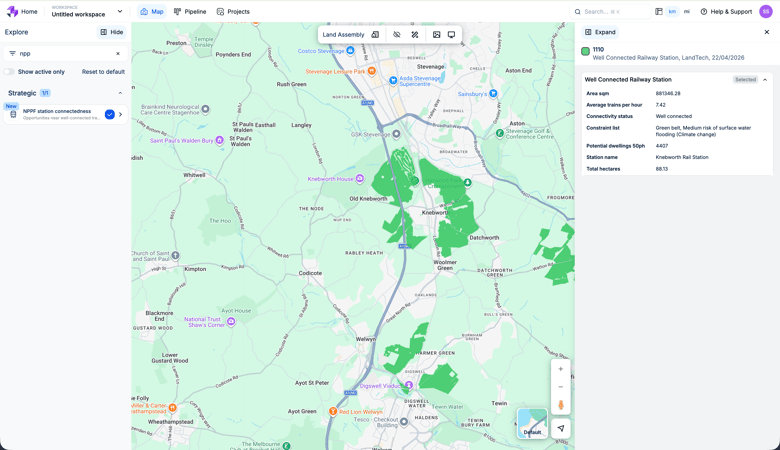
The layer is available under the Strategic section of the layers panel and is labelled NPPF station connectedness. It shows two categories:
- Well connected railway stations (green): stations meeting the four trains per hour or directional two per hour threshold within a top-60 TTWA
- Less connected railway stations (orange): stations in the two to four trains per hour range that may qualify directionally
Each parcel in the layer shows the key attributes you need to assess the opportunity quickly:
- Station name
- Connectivity status (well connected or less connected)
- Average trains per hour
- Area in square metres and total hectares
- Potential dwellings at 50 dwellings per hectare
- Constraint list (including Green Belt, flood risk, and other NPPF footnote 7 constraints)
How the Walking Catchment is Calculated
Rather than drawing a simple 800 metre radius, which overstates accessibility and does not reflect how people actually walk, LandTech models the real path network around each qualifying station. This produces an isochrone-based walking catchment that more accurately reflects which land parcels are genuinely accessible on foot. This matters for planning arguments: isochrone-based evidence is stronger than radius-based evidence when supporting a promotion case.
What the Data Does and Does Not Tell You
The layer identifies land that is accessible from qualifying stations and flags known constraints, but it is a strategic triage tool, not a site-specific verdict. It does not account for infrastructure capacity (water, sewage, highways), ownership fragmentation, or the full suite of material considerations that apply at planning application stage. A site showing as unconstrained in the layer should be the starting point for assessment, not the end of it.
Green Belt land is retained and flagged in the constraint list rather than excluded, because the station connectivity policy is one of the few routes to residential development promotion in the Green Belt that does not require an exceptional circumstances argument. A Green Belt flag here is not a reason to discard a site: it is a prompt to understand whether the policy hook applies.
How to Use It In Your Workflow
- Open the layers panel and navigate to Strategic
- Toggle on NPPF station connectedness
- Use the two categories to focus on well-connected stations first, or include less connected stations depending on your pipeline strategy
- Click on any parcel to see the full attribute panel: station name, trains per hour, potential dwellings, and constraint list
- Cross-reference with ownership, planning history, and other constraint layers to build your initial assessment
The layer integrates with the rest of your LandInsight workflow, so you can move from identifying a parcel to checking ownership, planning applications, and comparable values without leaving the platform.
The Window to Act Is Now
The final NPPF is expected in Summer 2026. Once it is published, land values around qualifying stations will adjust. The opportunity to identify, assess, and optioneer sites ahead of that adjustment is a matter of months, not years.
To understand the full national picture, download The Station Opportunity whitepaper or read the data-led analysis on our blog.
